The Marriage Supper Parable - A Cartoon with Sound Effects, Music, and Scripture - A Teaching of Jesus in Matthew 22

(See the PDF file here: https://drive.google.com/file/d/1-l2aOUz80mv-LIyzzPpySegRgZDMaDLT/view?usp=sharing .) The Marriage...

Showing posts with label occult. Show all posts

Monday, June 17, 2019

Narnia Promotes Paganism and Witchcraft (Part 2 of 2) -- Paganism and Speaking with Familiar Spirits or Spirit Guides


____________________________________


Paganism and Speaking with Familiar Spirits or Spirit Guides 
Is Found in Narnia

Narnia Promotes Paganism and Witchcraft 
(Part 2 of 2)

{Click Here for Part 1 of 2.}

Witchcraft in The Chronicles of Narnia


The Chronicles of Narnia stories are still popular today after their beginning in the 1950s. They have been made into several popular Hollywood films. Many Christians have embraced the books and treasured them along with other writings of C.S. Lewis. But, what is the reason for their continuing popularity? Could it be that they are more than just novels for entertainment?

Narnia Promotes Paganism and Witchcraft (Part 1 of 2) -- Telekinesis, Levitation, Witchcraft and NARNIA


____________________________________

Telekinesis, Levitation, Witchcraft and Narnia

Narnia Promotes Paganism and Witchcraft 
(Part 1 of 2)

{Click Here for Part 2 of 2.}

Witchcraft in The Chronicles of Narnia


The Chronicles of Narnia stories are still popular today after their beginning in the 1950s. They have been made into several popular Hollywood films. Many Christians have embraced the books and treasured them along with other writings of C.S. Lewis. But, what is the reason for their continuing popularity? Could it be that they are more than just novels for entertainment?

Narnia Contradicts the Bible and Is Anti-Christ (Witchcraft in The Chronicles of Narnia)


____________________________________


NARNIA CONTRADICTS
THE BIBLE AND IS ANTI-CHRIST

Witchcraft in The Chronicles of Narnia


The Chronicles of Narnia stories are still popular today after their beginning in the 1950s. They have been made into several popular Hollywood films. Many Christians have embraced the books and treasured them along with other writings of C.S. Lewis. But, what is the reason for their continuing popularity? Could it be that they are more than just novels for entertainment?

The late David J. Meyer, a former witch, became a believer in Jesus Christ and left witchcraft. He then exposed the real witchcraft in some popular books for children and adults. David J. Meyer wrote:

As a former witch, astrologer, and occultist who has been saved by the grace of God, I know that the works of C.S. Lewis are required reading by neophyte witches, especially in the United States and England. This includes The Chronicles of Narnia, because it teaches neophyte, or new witches, the basic mindset of the craft. Isn’t it strange, though, that many “Christian” churches and organizations have used The Chronicles of Narnia as Sunday School curriculum?” [End quote] (Meyer, David J. “The Witchcraft of the Narnia Chronicles.” lasttrumpetministries.org.) (Emphasis added)

{Note: A neophyte is a beginner witch.}

Let’s consider what David J. Meyer said about Narnia.

Friday, June 14, 2019

STAR WARS CONTRADICTS THE BIBLE AND IS ANTI-CHRIST


STAR WARS IS ANTI-CHRIST


(The Devil's Tool to Steal the Hearts of Christians)


||  STAR WARS CONTRADICTS
THE BIBLE AND IS ANTI-CHRIST  ||


Released to the world in 1977, Star Wars became a powerful phenomenon which drew millions of people into its profound influence. But, its power to captivate the minds, imaginations, and hearts of countless millions of people is not something that can be lightly ignored. Christians need to be aware of the messages and themes in Star Wars, especially since the Bible warned us about deceivers and evil people who would conduct amazing signs and wonders to deceive, if possible, God's people. 

The darkness in our world is increasing. We must be vigilant, as Christians, to watch and pray ... that is we need to know what God would show us personally and to pray as God leads us by His Holy Spirit. In the dark waters of this world, we need God's Holy Spirit and His Holy Bible to guide us when we consider the popular things in our culture and world.


Monday, June 12, 2017

Lord of the Rings Exposed - The Inklings and the Occult (J.R.R. Tolkien, C.S. Lewis, and Charles Williams)


Lord of the Rings Exposed - The Inklings and the Occult (J.R.R. Tolkien, C.S. Lewis, and Charles Williams)
Now posthumously famous around the world, J.R.R. Tolkien and C.S. Lewis have had a huge impact on our modern culture. Many video games, fantasy novels, and role-playing games (including Dungeons and Dragons) have been strongly influenced by The Lord of the Rings [A]. Gary Gygax, the maker of Dungeons and Dragons, originally incorporated story elements from Lord of the Rings before changing these when the game was sold to the public [A]. Tolkien, Lewis, and other Oxford professors and writers, together, formed a small group known as the "Inklings." They would meet together to discuss literature and read aloud their fiction manuscripts. We will now look at one "Inkling" in particular.
Charles Williams
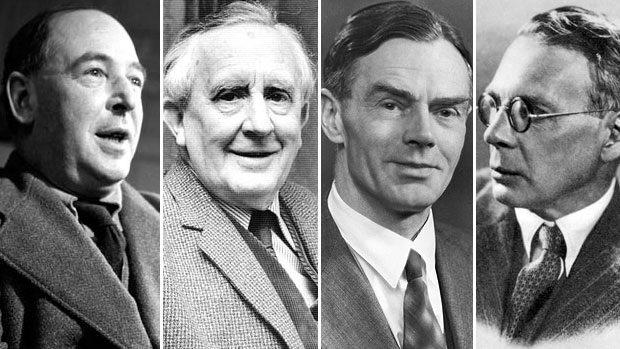
(Some of the "Inklings" including Lewis,
Tolkien, Owen Barfield, and Charles Williams)
A man you may not have heard of befriended J.R.R. Tolkien and C.S. Lewis, and played an important a role in influencing their writing. His name was Charles Williams, an esoteric author of novels, poems, and nonfiction works. What makes him an interesting character is his fascination with the occult. At the age of about 30, Williams joined a secret society that focused on occult rituals, ‘magick,’ and gnostic teachings.

Humphrey Carpenter wrote about Williams’s initiation (in 1917) into an esoteric, secret society called the Hermetic Order of the Golden Dawn [B]. From Carpenter’s book, The Inklings: C. S. Lewis, J. R. R. Tolkien and Their Friends, we read:

"Among its first initiates was a coroner who allegedly performed necromantic rites... while another early member was black magician Aleister Crowley, the self styled Great Beast.... But the Order of the Golden Dawn also included persons of less outlandish ways, such as W. B. Yeats, … A. E. Waite ....  It was this group that Williams joined.” [B.] [End quote]

Friday, June 9, 2017

The Lord of the Rings Exposed - Elves, Dwarves, Goblins, Trolls, Fairies, and Wizards (What Are They? Do They Exist or Did They Exist at One Time?)


The Lord of the Rings Exposed - Elves, Dwarves, Goblins, Trolls, Fairies, and Wizards (What Are They? Do They Exist or Did They Exist at One Time?)

In The Lord of the Rings and The Hobbit (and Narnia), we read about dwarves, trolls, goblins, elves, and other mythical creatures. These creatures have been featured in myths going back thousands or hundreds of years. J.R.R. Tolkien drew from these myths to write his famous Lord of the Rings series and associated books. But, are these creatures only found in fantasy and myths?


What Is a Dwarf?

I did a Google search and found a book by a Wiccan describing, in a matter-of-fact way, how a witch (or Wiccan) could summon various spirit creatures, such as gnomes, dwarves, elves, and others. Listen to what Mr. Skye Alexander writes concerning gnomes and dwarves:

Gnomes, whose name means “earth dwellers,” dwell in the element of earth. …. At times, however, they can seem gruff… Sometimes called trolls or leprechauns, these elementals are practical, no-nonsense,... creatures. They … can be valuable aides when you’re doing prosperity spells. Other earth spirits include the dwarves of European faery tales [sic], the bergbui (Teutonic mountain giants), the kubera (Hindu guardians of the north), and the simargl (Slavic guardians of all plants). If you wish to work with a gnome, go to a wooded area, call to it, and wait patiently until it reveals itself to you or you sense its presence.”’ [A.] [End quote] (underlining added)

If you are familiar with the Bible, you will know that God forbids communicating with familiar spirits in Deuteronomy 18.

Deuteronomy 18:10-11
“[10] There shall not be found among you any one that maketh his son or his daughter to pass through the fire, or that useth divination, or an observer of times, or an enchanter, or a witch, [11] Or a charmer, or a consulter with familiar spirits, or a wizard, or a necromancer.”

It is strange to most people, but Wiccans (“white” witches) actually communicate with spirits they call dwarves, elves, fairies, gnomes, etc.

What Are Fairies and Elves?

Thursday, June 8, 2017

Harry Potter - Is It Pretend, or Is It Real Witchcraft?


Harry Potter - Is It Pretend, or Is It Real Witchcraft?

Harry Potter began in 1997 and became a global phenomenon. It spawned eight Hollywood films, many toys, and a greater interest in kids for the occult (esoteric or “hidden knowledge”). But, we ask: ‘Is it pretend magic, or is it real witchcraft that J.K. Rowling is teaching through her books?’
We’ll start with the pointy, wizard hats that can be found throughout Harry Potter, Lord of the Rings, and other fantasy stories.


The Pointy Hat or the Wizard Hat

Witches have been associated with pointy hats for a few hundred years. The origin of the pointy, wizard hat, some archeologists and historians now believe, comes from pointy, gold objects from the Bronze Age. These metal objects were fashioned with astrological symbols and were believed, by some historians, to be worn by people known as “king-priests.” They were thought to be both a type of wizard and a political leader. And, their hats were believed to help them predict the movement of the sun and stars. [A.]

In Harry Potter books and films, the students at Hogwarts school of witchcraft and wizardry occasionally wear pointy hats. But, some of the teachers wear them often. One such person is Minerva McGonagall.

Professor Minerva McGonagall

Wednesday, June 7, 2017

Star Wars Exposed - Necromancy Exposed in Star Wars


Star Wars Exposed - Necromancy Exposed in Star Wars


In the best-selling books and movies of the last 40 years (or so), Star Wars is near the top. It has become a global phenomenon and now Disney has gotten its hands into the franchise. We are seeing more and more people eager to purchase Star Wars toys, games, books, and movies for themselves and their children. But, does Star Wars promote the occult? Does it promote sorcery? Jedi knights don’t wear pointy hats or hold magic wands, but are they sorcerers?

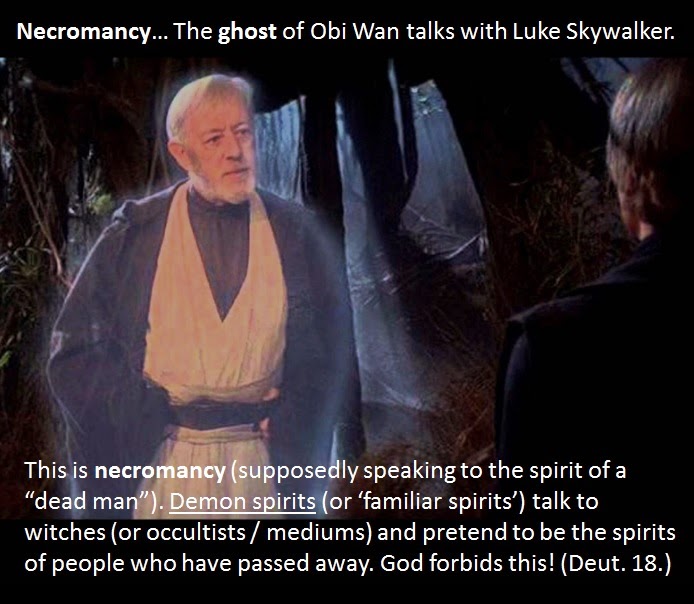
In the Star Wars films we see a few times when either Obi Wan or Yoda (or or other deceased Jedi) return in a semi-transparent, ghostly form. In The Clone Wars (a Cartoon Network show), Anakin Skywalker speaks with Qui Gon Jinn’s ‘ghost.’ At another time, Obi Wan speaks with the same Qui Gon ‘ghost.’ (Note: I don’t watch Star Wars films or videos anymore. I just found the video clips of this ghostly interaction by internet search.)

In the original Star Wars films, Obi Wan’s ghost appeared to Luke Skywalker, and counseled him. Is this necromancy? Dictionary.com defines necromancy as: “a method of divination through alleged communication with the dead; black art.” [B.]

The practice of speaking with the “dead” is called necromancy, when seeking wisdom or knowledge by occult means. This is a type of divination. God forbids divination, necromancy, wizardry, and magic in Deuteronomy 18.

Deuteronomy 18:9-13

“[9] When thou art come into the land which the Lord thy God giveth thee, thou shalt not learn to do after the abominations of those nations. [10] There shall not be found among you any one that maketh his son or his daughter to pass
through the fire, or that useth divination, or an observer of times, or an enchanter, or a witch. [11] Or a charmer, or a consulter with familiar spirits, or a wizard, or a necromancer.

[12] For all that do these things are an abomination unto the Lord: and because of these abominations the Lord thy God doth drive them out from before thee. [13] Thou shalt be perfect with the Lord thy God.”

The belief that the spirits of dead people remain on earth is a pagan and occult idea. (To learn more about what these spirits are, click here.) The Bible says:


Harry Potter Magic Exposed - Necromancy in Hogwarts


Harry Potter Magic Exposed - Necromancy in Hogwarts

Ghosts appear in Harry Potter’s Hogwarts school. They lurk in the old grounds of this school of witchcraft and wizardry. They also communicate with Harry and his classmates.

One ghost, called Nearly Headless Nick, told Harry Potter these words: “I know nothing of the secrets of death, Harry, for I chose my feeble imitation of life instead.” [A.]

Harry Potter is being taught to be a wizard; to talk with spirits; how to cast spells; and to use magic for “good” purposes. But, all of these things are forbidden in God’s Word, the Bible, in Deuteronomy 18.

The Lord of the Rings Exposed - The Magic Mirror and the "Palantir" Exposed (SHORT VERSION)


The Lord of the Rings Exposed - The Magic Mirror and the "Palantir" Exposed (SHORT VERSION)


(This is a shorter version of an article I recently wrote. If you want more details, read the longer version here.)

Dear brothers and sisters in Christ, I am writing this article about The Lord of the Rings to encourage you to seek God about this topic -- to seek God about what He wants you to know regarding The Hobbit and The Lord of the Rings books. Are they full of magic that real witches and wizards use, or are they just fantasy stories that are harmless? Is Gandalf, the wizard character, redeemable, or not?

We will focus on two items in this article that you may not be aware of.

The Magic Mirror or Pool of Galadriel


In The Fellowship of the Ring, Galadriel, an elf lady, takes some people to view a magic pool. There, Samwise Gamgee (a hobbit) gazes into the magic pool and magically sees events happening far away (allegedly). Tolkien writes:

“Down a long flight of steps …. At the bottom, ... stood a basin of silver, wide and shallow, and beside it stood a silver ewer.

With water from the stream Galadriel filled the basin to the brim, ... she spoke. `Here is the Mirror of Galadriel,' she said. 'I have brought you here so that you may look in it, if you will.'

.... 'What shall we look for, and what shall we see?' asked Frodo, filled with awe.

`Many things I can command the Mirror to reveal,' she answered, `and to some I can show what they desire to see. But the Mirror will also show things unbidden, … and more profitable than things which we wish to behold. …. For it shows things that were, and things that are, things that yet may be. …. Do you wish to look?'" [A.] [End quote]

The magic pool or mirror of Galadriel is no different that a mirror for divination, or a scrying mirror (or pool). Scrying mirrors are sold online and in witchcraft shops. The practice of gazing into a magic mirror or pool is used for divination, or gaining hidden knowledge. God forbids divination in Deuteronomy 18 and throughout the Bible. God said through Moses: “There shall not be found among you any one that ... or that useth divination,....” (Deuteronomy 18:10).

But, divination is not only practiced and promoted in The Fellowship of the Ring. A crystal ball is used in The Two Towers.

The Crystal Ball (“Palantír” globe)


In The Two Towers, Gandalf obtained a crystal ball (called a “Palantir”) from a wizard’s tower (Isengard), after Gandalf had defeated Saruman, an “evil” wizard. One night, Pippin stole the crystal ball to look into it. The hobbit gazes into its black depths until he sees images appearing. He hears a voice speaking to him, in his mind. It is Sauron, an “evil” wizard, who runs the evil country of Mordor.

Tolkien writes:

The Lord of the Rings Exposed - The Magic Mirror and the "Palantir" Exposed


The Lord of the Rings Exposed - The Magic Mirror and the "Palantir" Exposed


(To read a shorter version of this article, click here.)

Dear brothers and sisters in Christ, I am writing this article about The Lord of the Rings to encourage you to seek God about this topic -- to seek God about what He wants you to know regarding The Hobbit and The Lord of the Rings books. Are they full of magic that real witches and wizards use, or are they just fantasy stories that are harmless? Is Gandalf, the wizard character, redeemable, or not?

We will focus on two items in this article that we will spend a little time looking at. Before we go there, I’d like to show you, briefly, how many times certain important words appear in The Lord of the Rings: The Fellowship of the Ring.

“Magic” appears 18 Times in The Fellowship of the Ring.


The words “Magic”, “Magician,” and “Magical” appear 18 times in The Fellowship of the Ring. “Sorcerer” and “sorcery” each appear once. “Wizard” appears 58 times in the actual text of the story. The word “power” is often found in the context of magical power throughout the book. (I used a word search box on a pdf file to count these words for me.)

The Magic Mirror or Pool of Galadriel


In The Fellowship of the Ring, Galadriel, an elf lady, takes some people to view a magic pool. There, Samwise Gamgee (a hobbit) gazes into the magic pool and magically sees events happening far away (allegedly). Tolkien writes:


“Down a long flight of steps …. At the bottom, upon a low pedestal carved like a branching tree, stood a basin of silver, wide and shallow, and beside it stood a silver ewer.

With water from the stream Galadriel filled the basin to the brim, and breathed on it, and when the water was still again she spoke. `Here is the Mirror of Galadriel,' she said. 'I have brought you here so that you may look in it, if you will.'

Friday, June 2, 2017

The Occult in Narnia, Part 4 - The White Witch and The Magician's Nephew


The Occult in Narnia, Part 4 - The White Witch and The Magician's Nephew


In this article we will look at the White Witch (Jadis) from The Chronicles of Narnia, by C.S. Lewis. We will show you some information about her that will alarm you (likely) and will open a door to C.S. Lewis' belief system.

One of the main characters in The Chronicles of Narnia is the White Witch, known as Jadis, who was a queen and a sorceress who came from a magical world known as Charn. In The Magician's Nephew, some decades before the events in The Lion the Witch and the Wardrobe took place, a boy named Digory (who grew up to be Professor Digory) and a girl named Polly used magic rings to travel to a magical world called Charn


Jadis, the White Witch


The two magically appeared in a courtyard of a stone building. Entering the building, they found a room in which were many well-dressed people that were motionless as statues, due to a magic spell cast on them years ago. The two children noticed a gold bell and an inscription beside it. C.S. Lewis writes:

Thursday, June 1, 2017

The Occult in Narnia, Part 3 - ASLAN and BACCHUS - Narnia's Occult Agenda

The Occult in Narnia, Part 3 - Aslan and Bacchus 

(Narnia's Occult Agenda)


C.S. Lewis, the author of The Chronicles of Narnia, claimed to be a Christian, but did his writings reflect he was a Christian? What we need to know is what C.S. Lewis' books for children portray their protagonists like, especially the lion character Aslan. Aslan is the giant cat that befriended Lucy and her siblings. Throughout the Narnia books, Lucy is certainly the main protagonist, and Aslan is her companion, who she admires and loves. Many Christians have said that Aslan is an allegorical figure of Christ, but is that what C.S. Lewis really intended? 

Was Aslan Really Allegorical or Not? 


In a letter addressed to Mrs. Hook (from 1958), C.S. Lewis wrote:  

"[Aslan] is an invention giving an imaginary answer to the question ‘What might Christ become like if there really were a world like Narnia and He choose to be incarnate and die and rise again in that world as He actually has done in ours?’ This is not allegory at all." [1]

NarniaWeb wrote: 'According to Lewis, an author puts into an allegory “only
what he already knows,” but in a myth, he puts “what he does not yet know
and could not come by in any other way.”' [1]. Lewis said that Narnia was a myth, not an allegory.

Lewis wrote to a lady named Sophia Storr: When I started The Lion, the Witch and the Wardrobe, I don’t think I foresaw what Aslan was going to do and suffer. I think He just insisted on behaving in His own way.” [1]

Instead of C.S. Lewis planning out how to make a symbol of Christ, he imagined a mythical land in which a Christ-like lion existed. This lion could do things that the real Jesus Christ never did, and live out his life in a make-believe world that was not constrained to the format of an allegory. {See "References" section [1].} 

C.S. Lewis wrote about the difference between Narnia and allegories like Pilgrim's Progress in a letter "to a lady" from December 29, 1958:

"Allegory and such supposals differ because they mix the real and the unreal in different ways. Bunyan's picture of Giant Despair does not start from supposal at all. It is not a supposition but a fact that despair can capture and imprison a human soul. What is unreal (fictional) is the giant, the castle, and the dungeon. The Incarnation of Christ in another world is mere supposal; but granted the supposition, He would really have been a physical object in that world as He was in Palestine and His death on the Stone Table would have been a physical event no less than his death on Calvary." [2]

That is telling. Aslan is not a direct representation of Jesus Christ in the same way that "Giant Despair" (in John Bunyan's Pilgrim's Progress) represents the feeling of despair people face. But the Aslan character is more than just a "supposal." He had a role to play in promoting a character called Bacchus in another Narnia book. Before we look at that, let's see what a former witch has to say about Narnia.

A Former Witch Speaks Out About Narnia.


The late David J. Meyer, who was a witch that left witchcraft for Jesus Christ, wrote about Narnia and about Aslan, revealing some facts most people wouldn't know. Meyer wrote:

"As a former witch, astrologer, and occultist who has been saved by the grace of God, I know that the works of C.S. Lewis are required reading by neophyte witches, especially in the United States and England. This includes The Chronicles of Narnia, because it teaches neophyte, or new witches, the basic mindset of the craft. Isn’t it strange, though, that many “Christian” churches and organizations have used The Chronicles of Narnia as Sunday School curriculum?" [3]

You just heard him say that C.S. Lewis' books, including the Narnia books, are required reading for beginner (neophyte) witches. That should be enough reason to stop reading Lewis' books and watching Narnia movies. 

Interestingly, a Catholic website mentioned that pagans (or Wiccans) read Narnia and Lord of the Rings, and enjoy them:

"Many pagans say that their favorite book in childhood was J.R.R. Tolkien’s Lord of the Rings. .... Pagans also read the Chronicles of Narnia series by C.S. Lewis, ...." [4]

David J. Meyer speaks of the significance of the time of year that The Lion, the Witch, and the Wardrobe was released (Dec. 9, 2005). He writes:

"When I saw the release date of this new movie, I was not surprised. December 9th is the 13th day before the witches’ quarter-sabat of Yule. The full cold moon is midway between the release date and the sabat of Yule. The waxing moon is also directly on the equinox on the release date of the movie. This is far too precisely occultic to be coincidental, and the producers of the movie no doubt consulted upper-level witches regarding the perfect day to have the “Chronicles of Narnia” open." [3]

C.S. Lewis places Bacchus, a pagan god of wine, in Narnia.


Later in the article, Meyer wrote how C.S. Lewis included Bacchus, the pagan god of wine and lust in Prince Caspian: The Return to Narnia. Meyer wrote:

'Remember, Aslan the lion is esteemed to be the “Christ figure” by so many “Christian” teachers, but with that in mind, consider the following quotes from The Chronicles of Narnia." [3]

From Prince Caspian:

"The crowd and the dance round Aslan (for it had become a dance once more) grew so thick and rapid that Lucy was confused. She never saw where certain other people came from who were soon capering about among the trees. One was a youth, dressed only in a fawn-skin, with vine-leaves wreathed in his curly hair. His face would have been almost too pretty for a boy's, if it had not looked so extremely wild. You felt, as Edmund said when he saw him a few days later, "There's a chap who might do anything—absolutely anything." He seemed to have a great many names—Bromios, Bassareus, and the Ram were three of them. There were a lot of girls with him, as wild as he. There was even, unexpectedly, someone on a donkey. And everybody was laughing: and every body was shouting out, "Euan, euan, eu-oi-oi-oi." [5] (bold added)

Meyer writes: