The Marriage Supper Parable - A Cartoon with Sound Effects, Music, and Scripture - A Teaching of Jesus in Matthew 22

(See the PDF file here: https://drive.google.com/file/d/1-l2aOUz80mv-LIyzzPpySegRgZDMaDLT/view?usp=sharing .) The Marriage...

Showing posts with label c.s. lewis. Show all posts

Monday, June 17, 2019

Narnia Promotes Paganism and Witchcraft (Part 2 of 2) -- Paganism and Speaking with Familiar Spirits or Spirit Guides


____________________________________


Paganism and Speaking with Familiar Spirits or Spirit Guides 
Is Found in Narnia

Narnia Promotes Paganism and Witchcraft 
(Part 2 of 2)

{Click Here for Part 1 of 2.}

Witchcraft in The Chronicles of Narnia


The Chronicles of Narnia stories are still popular today after their beginning in the 1950s. They have been made into several popular Hollywood films. Many Christians have embraced the books and treasured them along with other writings of C.S. Lewis. But, what is the reason for their continuing popularity? Could it be that they are more than just novels for entertainment?

Narnia Promotes Paganism and Witchcraft (Part 1 of 2) -- Telekinesis, Levitation, Witchcraft and NARNIA


____________________________________

Telekinesis, Levitation, Witchcraft and Narnia

Narnia Promotes Paganism and Witchcraft 
(Part 1 of 2)

{Click Here for Part 2 of 2.}

Witchcraft in The Chronicles of Narnia


The Chronicles of Narnia stories are still popular today after their beginning in the 1950s. They have been made into several popular Hollywood films. Many Christians have embraced the books and treasured them along with other writings of C.S. Lewis. But, what is the reason for their continuing popularity? Could it be that they are more than just novels for entertainment?

Narnia Contradicts the Bible and Is Anti-Christ (Witchcraft in The Chronicles of Narnia)


____________________________________


NARNIA CONTRADICTS
THE BIBLE AND IS ANTI-CHRIST

Witchcraft in The Chronicles of Narnia


The Chronicles of Narnia stories are still popular today after their beginning in the 1950s. They have been made into several popular Hollywood films. Many Christians have embraced the books and treasured them along with other writings of C.S. Lewis. But, what is the reason for their continuing popularity? Could it be that they are more than just novels for entertainment?

The late David J. Meyer, a former witch, became a believer in Jesus Christ and left witchcraft. He then exposed the real witchcraft in some popular books for children and adults. David J. Meyer wrote:

As a former witch, astrologer, and occultist who has been saved by the grace of God, I know that the works of C.S. Lewis are required reading by neophyte witches, especially in the United States and England. This includes The Chronicles of Narnia, because it teaches neophyte, or new witches, the basic mindset of the craft. Isn’t it strange, though, that many “Christian” churches and organizations have used The Chronicles of Narnia as Sunday School curriculum?” [End quote] (Meyer, David J. “The Witchcraft of the Narnia Chronicles.” lasttrumpetministries.org.) (Emphasis added)

{Note: A neophyte is a beginner witch.}

Let’s consider what David J. Meyer said about Narnia.

Saturday, June 3, 2017

The Occult in Narnia, Part 5 - The Magic Spell Book in Narnia

The Occult in Narnia, Part 5 - The Magic Spell Book in Narnia


In this article, we will look at C.S. Lewis' provocative description of magic spells which Lucy used from a magic spell-book, in The Voyage of the Dawn Treader. We will see what the Bible has to say about this subject. And, we will look at something that Aslan himself said to Lucy which will surprise you.


The Number of Times "Magic" and "Spell" Appear in Narnia Books


The word "magic" appears throughout the Narnia books, as would make obvious sense, since these books are meant to be about a magical land called Narnia, where Aslan, a lion, can magically fly, and animals can talk. But, the context of the word "magic" in the Narnia books is not used in the way some people might say, "That was a magical date" or "That was a magical outing." It is used to refer to supernatural power that can be controlled by way of magic rings or spells. This is nothing different than witchcraft, which also uses magic rings and magic spells to control something they call "the force." (See the References section at the end.) 

By using the gutenberg.ca website, I tracked how many times the word "magic" appeared in Narnia books, and how many times the word "spell" appeared (in the context of a magic spell). There was one time the word "spell" was used in a sentence in the context of spelling a word. (In Prince Caspian: "...in the most abhominable,—don't forget to spell it with an H, Doctor..." [sic]) But, almost all appearances of the word "spell" referred to magic spells. 

Below is a list of the Narnia books with the number of times the word "spell" (in the context of magic) and the word "magic" (including other forms such as magical) appear in the actual novel text of Narnia books:

- THE LION, THE WITCH and THE WARDROBE ("spell" appears 2 times; "magic" appears 23 times)

- THE SILVER CHAIR ("magic" appears 13 times)

- THE VOYAGE OF THE DAWN TREADER ("spell" appears 24 times; "magic" appears 58 times)

- THE MAGICIAN'S NEPHEW ("spell" appears 5 times; "magic" appears 62 times; "Rings" [magic rings] appears 52 times; [note: "roarings" appears 1 time])

- PRINCE CASPIAN ("spell" appears 4 times; "magic" appears 31 times)

- THE HORSE AND HIS BOY ("magic" appears 3 times)

- THE LAST BATTLE ("magic" appears 3 times; "Rings" [magic rings] appears 7 times)

In total, the word "magic" appears 193 times and "spell" (as in a magic spell) appears 35 times in The Chronicles of Narnia books.


The Magic Spell-Book in Narnia


One example of the word spell is found in this short scene from The Voyage of the Dawn Treader. C.S. Lewis writes:

'"I do not know, Madam," said Reepicheep. "But there is this. When I was in my cradle a wood woman, a Dryad, spoke this verse over me:

"Where sky and water meet,
Where the waves grow sweet,
Doubt not, Reepicheep,
To find all you seek,
There is the utter East.

"I do not know what it means. But the spell of it has been on me all my life."' [End quote] [1]


In the same story, there is a chapter titled "The Magician's Book." Lucy, the main character, is in a wizard's house, looking at a magic spell-book. C.S. Lewis writes a vibrant description:

"She went up to the desk and laid her hand on the book; her fingers tingled when she touched it as if it were full of electricity. She tried to open it but couldn't at first; this, however, was only because it was fastened by two leaden clasps, and when she had undone these it opened easily enough. And what a book it was!

It was written, not printed; written in a clear, even hand, with thick downstrokes and thin upstrokes, very large, easier than print, and so beautiful that Lucy stared at it for a whole minute and forgot about reading it. The paper was crisp and smooth and a nice smell came from it; and in the margins, and round the big coloured capital letters at the beginning of each spell, there were pictures.


There was no title page or title; the spells began straight away, and at first there was nothing very important in them. They were cures for warts (by washing your hands in moonlight in a silver basin) and toothache and cramp, and a spell for taking a swarm of bees. 

[...]

She turned on and found to her surprise a page with no pictures at all; but the first words were A Spell to make hidden things visible. She read it through to make sure of all the hard words and then said it out loud. And she knew at once that it was working because as she spoke the colours came into the capital letters at the top of the page and the pictures began appearing in the margins." [End quote] [1]


Here C.S. Lewis is describing a scene where a little girl (Lucy) is reading from a magic spell-book and causing magical things to start appearing. She even caused Aslan to magically appear, due to the spell she cast to turn invisible things visible. That is concerning, because Aslan is supposed to be a character that represents Christ. 


Aslan Said Something Disturbing to Lucy.


Friday, June 2, 2017

The Occult in Narnia, Part 4 - The White Witch and The Magician's Nephew


The Occult in Narnia, Part 4 - The White Witch and The Magician's Nephew


In this article we will look at the White Witch (Jadis) from The Chronicles of Narnia, by C.S. Lewis. We will show you some information about her that will alarm you (likely) and will open a door to C.S. Lewis' belief system.

One of the main characters in The Chronicles of Narnia is the White Witch, known as Jadis, who was a queen and a sorceress who came from a magical world known as Charn. In The Magician's Nephew, some decades before the events in The Lion the Witch and the Wardrobe took place, a boy named Digory (who grew up to be Professor Digory) and a girl named Polly used magic rings to travel to a magical world called Charn


Jadis, the White Witch


The two magically appeared in a courtyard of a stone building. Entering the building, they found a room in which were many well-dressed people that were motionless as statues, due to a magic spell cast on them years ago. The two children noticed a gold bell and an inscription beside it. C.S. Lewis writes:

Thursday, June 1, 2017

The Occult in Narnia, Part 3 - ASLAN and BACCHUS - Narnia's Occult Agenda

The Occult in Narnia, Part 3 - Aslan and Bacchus 

(Narnia's Occult Agenda)


C.S. Lewis, the author of The Chronicles of Narnia, claimed to be a Christian, but did his writings reflect he was a Christian? What we need to know is what C.S. Lewis' books for children portray their protagonists like, especially the lion character Aslan. Aslan is the giant cat that befriended Lucy and her siblings. Throughout the Narnia books, Lucy is certainly the main protagonist, and Aslan is her companion, who she admires and loves. Many Christians have said that Aslan is an allegorical figure of Christ, but is that what C.S. Lewis really intended? 

Was Aslan Really Allegorical or Not? 


In a letter addressed to Mrs. Hook (from 1958), C.S. Lewis wrote:  

"[Aslan] is an invention giving an imaginary answer to the question ‘What might Christ become like if there really were a world like Narnia and He choose to be incarnate and die and rise again in that world as He actually has done in ours?’ This is not allegory at all." [1]

NarniaWeb wrote: 'According to Lewis, an author puts into an allegory “only
what he already knows,” but in a myth, he puts “what he does not yet know
and could not come by in any other way.”' [1]. Lewis said that Narnia was a myth, not an allegory.

Lewis wrote to a lady named Sophia Storr: When I started The Lion, the Witch and the Wardrobe, I don’t think I foresaw what Aslan was going to do and suffer. I think He just insisted on behaving in His own way.” [1]

Instead of C.S. Lewis planning out how to make a symbol of Christ, he imagined a mythical land in which a Christ-like lion existed. This lion could do things that the real Jesus Christ never did, and live out his life in a make-believe world that was not constrained to the format of an allegory. {See "References" section [1].} 

C.S. Lewis wrote about the difference between Narnia and allegories like Pilgrim's Progress in a letter "to a lady" from December 29, 1958:

"Allegory and such supposals differ because they mix the real and the unreal in different ways. Bunyan's picture of Giant Despair does not start from supposal at all. It is not a supposition but a fact that despair can capture and imprison a human soul. What is unreal (fictional) is the giant, the castle, and the dungeon. The Incarnation of Christ in another world is mere supposal; but granted the supposition, He would really have been a physical object in that world as He was in Palestine and His death on the Stone Table would have been a physical event no less than his death on Calvary." [2]

That is telling. Aslan is not a direct representation of Jesus Christ in the same way that "Giant Despair" (in John Bunyan's Pilgrim's Progress) represents the feeling of despair people face. But the Aslan character is more than just a "supposal." He had a role to play in promoting a character called Bacchus in another Narnia book. Before we look at that, let's see what a former witch has to say about Narnia.

A Former Witch Speaks Out About Narnia.


The late David J. Meyer, who was a witch that left witchcraft for Jesus Christ, wrote about Narnia and about Aslan, revealing some facts most people wouldn't know. Meyer wrote:

"As a former witch, astrologer, and occultist who has been saved by the grace of God, I know that the works of C.S. Lewis are required reading by neophyte witches, especially in the United States and England. This includes The Chronicles of Narnia, because it teaches neophyte, or new witches, the basic mindset of the craft. Isn’t it strange, though, that many “Christian” churches and organizations have used The Chronicles of Narnia as Sunday School curriculum?" [3]

You just heard him say that C.S. Lewis' books, including the Narnia books, are required reading for beginner (neophyte) witches. That should be enough reason to stop reading Lewis' books and watching Narnia movies. 

Interestingly, a Catholic website mentioned that pagans (or Wiccans) read Narnia and Lord of the Rings, and enjoy them:

"Many pagans say that their favorite book in childhood was J.R.R. Tolkien’s Lord of the Rings. .... Pagans also read the Chronicles of Narnia series by C.S. Lewis, ...." [4]

David J. Meyer speaks of the significance of the time of year that The Lion, the Witch, and the Wardrobe was released (Dec. 9, 2005). He writes:

"When I saw the release date of this new movie, I was not surprised. December 9th is the 13th day before the witches’ quarter-sabat of Yule. The full cold moon is midway between the release date and the sabat of Yule. The waxing moon is also directly on the equinox on the release date of the movie. This is far too precisely occultic to be coincidental, and the producers of the movie no doubt consulted upper-level witches regarding the perfect day to have the “Chronicles of Narnia” open." [3]

C.S. Lewis places Bacchus, a pagan god of wine, in Narnia.


Later in the article, Meyer wrote how C.S. Lewis included Bacchus, the pagan god of wine and lust in Prince Caspian: The Return to Narnia. Meyer wrote:

'Remember, Aslan the lion is esteemed to be the “Christ figure” by so many “Christian” teachers, but with that in mind, consider the following quotes from The Chronicles of Narnia." [3]

From Prince Caspian:

"The crowd and the dance round Aslan (for it had become a dance once more) grew so thick and rapid that Lucy was confused. She never saw where certain other people came from who were soon capering about among the trees. One was a youth, dressed only in a fawn-skin, with vine-leaves wreathed in his curly hair. His face would have been almost too pretty for a boy's, if it had not looked so extremely wild. You felt, as Edmund said when he saw him a few days later, "There's a chap who might do anything—absolutely anything." He seemed to have a great many names—Bromios, Bassareus, and the Ram were three of them. There were a lot of girls with him, as wild as he. There was even, unexpectedly, someone on a donkey. And everybody was laughing: and every body was shouting out, "Euan, euan, eu-oi-oi-oi." [5] (bold added)

Meyer writes: 

Wednesday, May 31, 2017

The Real Witchcraft of Narnia Exposed - Narnia's Occult Agenda

The Real Witchcraft of Narnia Exposed - Narnia's Occult Agenda (Part 2)


In this short series, we will show facts about C.S. Lewis and his books that will challenge the belief many hold that ‘C.S. Lewis was a Christian author of good children’s stories and Christian books.’ Today, we will look at some of the occultic themes found in The Chronicles of Narnia. We will ask and answer the question: 'Is real witchcraft portrayed in C.S. Lewis' Narnia series?' 

In pre-medieval times, Europe was primarily made up of pagan tribes, such as the Celts, Goths, Picts, and others. These tribes often worshiped gods and goddesses, such as Thor, Oden, and Aine (a Celtic fertility goddess). People in ancient Europe often claimed to have seen supernatural beings appear in wooded areas and elsewhere. 


The Peterborough Chronicle is a historical account of England written during the Middle Ages, after the Norman Conquest of 1066. A supernatural event was reported to have been witnessed near the town of Peterborough. Through the woodland surrounding the town of Peterborough, large, hideous black creatures appeared, blowing horns, and many were riding black horses and he-goats. Read the actual account below:


"Many men both saw and heard a great number of huntsmen hunting. The huntsmen were black, huge, and hideous, and rode on black horses and on black he-goats, and their hounds were jet black, with eyes like saucers, and horrible. This was seen in the very deer park of the town of Peterborough, and in all the woods that stretch from that same town to Stamford, and in the night the monks heard them sounding and winding their horns." [1]

This account is one of many similar accounts of supernatural creatures making their appearance in what are called "wild hunts." As these events became more commonly known in Germanic lands, Scandinavia, Britain, and elsewhere, people included fairies in their retelling of the stories.


Jacques Vallee Reveals the True Nature of Aliens and Fairies 


Jacques Vallee, a well known UFO researcher, wrote in his book Passport to Magonia that from ancient times people have described encounters with fairies that seemed to have intercourse with human beings. Vallee compares demons with fairies in the same book:

"What we have here is a complete theory of contact between our race and another race, non-human, different in physical nature, but biologically compatible with us. Angels, demons, fairies, creatures from heaven, hell, or Magonia: they inspire our strangest dreams, shape our destinies, steal our desires......
But who are they?" [2]

The Bible reveals how a third of God's angels rebelled against Him, and became fallen angels that served Satan, who had been known as the angel Lucifer. Revelation 12 speaks of a great red dragon (Satan) who drew a third of the stars of heaven.
Revelation 12:3-4 a.
[3] And there appeared another wonder in heaven; and behold a great red dragon, having seven heads and ten horns, and seven crowns upon his heads. [4 a.] And his tail drew the third part of the stars of heaven, and did cast them to the earth: ..."

Isaiah 14:12 speaks how Lucifer (Satan) is fallen from Heaven. The prophecy says: "How art thou fallen from heaven, O Lucifer, son of the morning! how art thou cut down to the ground, which didst weaken the nations!" In Luke 10:18, Jesus said that He saw Satan fall from heaven. Luke 10:18 — "And he said unto them, I beheld Satan as lightning fall from heaven." Revelation 12 goes on to say how Satan was cast out of heaven with his angels.
Revelation 12:9 — "And the great dragon was cast out, that old serpent, called the Devil, and Satan, which deceiveth the whole world: he was cast out into the earth, and his angels were cast out with him."

These same evil spirits go forth seeking whom they may devour.
1 Peter 5:8-9 
[8] Be sober, be vigilant; because your adversary the devil, as a roaring lion, walketh about, seeking whom he may devour: [9] Whom resist stedfast in the faith, knowing that the same afflictions are accomplished in your brethren that are in the world.

These evil spirits can appear as angels of light to deceive men. 2 Corinthians 11:14 — "And no marvel; for Satan himself is transformed into an angel of light." They are deceivers and liars that make themselves appear like what they are not. If demons can appear as angels of light, why can't they appear as fairies, elves, leprechauns, dwarfs, trolls, monsters, dryads, nymphs, aliens, etc.?


Mr. Tumnus


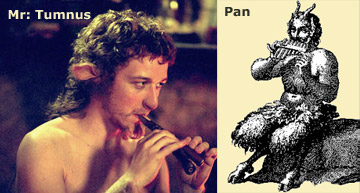
In The Chronicles of Narnia, many of these magical creatures are seen, including satyrs or fauns, such as Mr. Tumnus, who helped Lucy in The Lion, the Witch, and the Wardrobe. One of the most well known fauns is the pagan god Pan. Like Pan, Mr. Tumnus appears as a half man, half goat creature. Pan is known for being a symbol of lust, immorality, and paganism. Disturbingly, Mr. Tumnus (the Pan look-alike) brings a little girl to his cottage. He offers her tea and plays music that enchants Lucy. Here's what C.S. Lewis wrote (from The Lion, the Witch, and the Wardrobe):

"Then to cheer himself up he [Mr. Tumnus] took out from its case on the dresser a strange little flute that looked as if it were made of straw and began to play.
And the tune he played made Lucy want to cry and laugh and dance
and go to sleep all at the same time. It must have been hours later when she shook herself..." [3] 

In the 2005 movie adaptation, this magic flute causes magical figures to appear, dancing in the flickering fireplace flames of the cottage. IMDB said of the faun's music: "He plays a hypnotic tune on a flute-like instrument, and Lucy actually sees shapes form in the flames of Tumnus' hearth fire, shapes of a man riding a unicorn, and fauns and dryads dancing." [4]. 


Aslan Verses the White Witch


The magic flute is just the starting point for more occultic elements that Lewis will put in his Narnia books. The very fact that a children's story is portraying an "evil" witch who has the power to put spells on an entire country to cause a perpetual winter is disturbing, knowing that real witches do exist today. Making a witch seem powerful and able to cause perpetual winter is not biblical because the devil does not have the power to do such a thing. The devil is the one behind all witchcraft. Satanists use a type of sorcery that knowingly requires the use of demons. The devil does not have the power to cause eternal winter or summer. But, in the Narnia world, this evil witch can cause everyone to suffer from the cold of winter.

Aslan, the lion character, appears on the scene to stop the evil witch and break her spell of winter. But, Aslan himself uses magic. The very way Lucy and her siblings arrived in Narnia was due to magic. But, in The Voyage of the Dawn Treader, a magic spell-book is used. 

Tuesday, May 30, 2017

The Real C.S. Lewis Exposed - Narnia's Occult Agenda


Narnia's Occult Agenda Exposed - The Witchcraft in the Chronicles of Narnia (C.S. Lewis Exposed) 
(Part 1)

Certainly, The Chronicles of Narnia has influenced generations of people. It has occupied much of their time both reading and watching Narnia books and films. The power of entertainment to influence Christians toward the occult realm is not just a theory. For instance, many Christians today believe that magic, when portrayed in movies or books, is “good” if it is used for “good” in the story.

In this short series, we will show facts about C.S. Lewis and his books that will challenge the belief many hold that ‘C.S. Lewis was a Christian author of good children’s stories and Christian books.’ In this article, we will look at some of the beliefs Lewis had about salvation from sin.

Some of the things Christians have said about C.S. Lewis’ Chronicles of Narnia


The editor of Christianity Magazine, John Buckeridge, said of Narnia that: “There is a Christian parable in there” [1].

In 2005, Christianity Today said of the first Narnia movie (The Lion, the Witch, and the Wardrobe): 'After all of the rumors, the fretting about literary fidelity, and the angst about religious agendas, we can praise director Andrew Adamson and his fine young actors for developing these "Sons of Adam" and "Daughters of Eve" into three-dimensional, engaging characters [2].’

The tone of this magazine movie review is positive, reflecting the attitude of many Christians toward Narnia. We need to know what the author of Narnia believes about God and His Word, the Bible, before we go further.

C.S. Lewis’ False Doctrine that He Taught


What the Narnia author believes makes all the difference. C.S. Lewis, who wrote The Chronicles of Narnia, and many other books, had a very unbiblical view of salvation from sin. See what Lewis wrote in his book Mere Christianity:

Friday, December 12, 2014

The Witchcraft of The Chronicles of Narnia


The Witchcraft of The Chronicles of Narnia

(Photo: The Lion, the Witch, and the Wardrobe.
Click for source.)

Centaurs, dryads, nymphs, fauns, and mythical creatures fill the world of Narnia. C.S. Lewis, the author of the popular book series, was fascinated with Greek mythology, paganism, and ancient England. His stories have had wide acclaim by many around the world and the recent Disney “Narnia” movies have brought in over $1.5 billion at the box office worldwide (1, see Works Cited below).

This article will look at The Chronicles of Narnia’s powerful occult presentation and will reveal truth about its author that most people do not know. We will see that Narnia presents real witchcraft to kids as something “appealing.”


C.S. Lewis and Magic


Narnia’s author, C.S. Lewis is a man with two faces. He was born on November 29, 1898 in Belfast, Northern Ireland (2). In the mid-1920s, Lewis joined a group of “intellectuals” called the “Inklings” of which J.R.R. Tolkien was a member. Lewis and Tolkien became good friends (2). During this time, Tolkien got Lewis interested in Catholicism and Lewis began to call himself a “Christian”.

As an alleged “Christian”, Lewis studied and embraced paganism. C.S. Lewis went on a trip to Greece with his wife, Joy. C.S. Lewis wrote:

"I had some ado to prevent Joy and myself from relapsing into Paganism in Attica! At Daphni it was hard not to pray to Apollo the Healer. But somehow one didn’t feel it would have been very wrong — would have only been addressing Christ sub specie Apollonius. We witnessed a beautiful Christian village ceremony in Rhodes and hardly felt a discrepancy." (3 and 4 in Works Cited) (bold / underline added)

Apollo and Jesus Christ are not similar in any way. Lewis was treating them as if they were identical or similar. Apollo was the pagan sun-god of Greece. He was said to ride a fiery chariot through the heavens. Sun-worship has been a part of pagan cultures for thousands of years and it is an abomination to God.

Exodus 20:1-3
1 And God spake all these words, saying,
2 I am the Lord thy God, which have brought thee out of the land of Egypt, out of the house of bondage.
3 Thou shalt have no other gods before me.

Worship of anything (or anyone) other than God is idolatry and God hates it. God must be the focus of a true Christian. Sports, hobbies, work, family, etc. should never be the first thing on a true Christian’s mind when he / she wakes up or the last thing when he / she goes to bed. Jesus Christ should be a Christian’s focus.


C.S. Lewis and the Occult


(Photo: Pan is a pagan god of drunkenness and immorality. Source.)
Sadly, many Christians do not understand the danger of how a book series of a “Christian” author could be bad. That is why I feel the need to write this article. I am not trying to attack C.S. Lewis. This article is to encourage Christians to seek God and to seek to know what God shows them about C.S. Lewis and The Chronicles of Narnia.

The Chronicles of Narnia begins in WW2 during the bombing of London. Four Pevensie kids, Lucy, Edmund, Peter, and Susan are sent to stay with Professor Digory Kirke during the war. In this first book, Lucy steps through a magic wardrobe and arrives in a mystical world called “Narnia”. She meets a faun (half man-half goat) called Mr. Tumnus. 
(A dryad from one of the Narnia movies. Source.)

In this magical world, animals can talk, pagan deities called river gods, nymphs, and dryads live in the rivers and in the trees. Mythical creatures including satyrs (similar to fauns), centaurs, merpeople (mermaid), minotaurs, ogres, unicorns, gouls, a phoenix, half-breed (half man-half driad), naiads, etc. populated Narnia (7). All these creatures come from paganism.

(Photo: A phoenix rising. Source.)
One of these mythical creatures, the phoenix (which can be found in an apple orchard in The Magician's Nephew) is a mythical bird which Freemasonry and occultists use as a universal symbol. Manly P. Hall, who was an occultist and a 33rd degree Freemason, wrote:

Monday, March 3, 2014

The C.S. Lewis Deception: The Author of The Chronicles of Narnia and His Pagan Beliefs


The C.S. Lewis Deception


C.S. Lewis, one of the most popular “Christian” authors and intellectuals to exist, has had a big impact on many Evangelical Christians. Several Hollywood movies have been made recently based on Lewis’s Narnia novels.

Many people have referenced him as a “patron saint” of modern Christianity.
Christianity Today calls C.S. Lewis "our patron saint" ("Still Surprised by Lewis").

But, what does C.S. Lewis really believe about Christianity?

Lewis said this while traveling through Greece with his wife in 1960:

 “I had some ado to prevent Joy (and myself) from lapsing into paganism in Attica! AT DAPHNI IT WAS HARD NOT TO PRAY TO APOLLO THE HEALER. BUT SOMEHOW ONE DIDN’T FEEL IT WOULD HAVE BEEN VERY WRONG--WOULD HAVE ONLY BEEN ADDRESSING CHRIST SUB SPECIE APOLLONIUS” (C.S. Lewis to Chad Walsh, May 23, 1960, cited from George Sayer, Jack: A Life of C.S. Lewis, 1994, p. 378) (Emphasis added).

Lewis is calling Apollo (a Greek sun-god) a type of Christ. This is blasphemy. Jesus Christ is the name of God’s only begotten Son. (See 1 Peter 1:3, Matthew 3:17, etc.).

1 Timothy 2:5 says:
“For there is one God, and one mediator between God and men, the man Christ Jesus;”

Acts 4:12 says:
“Neither is there salvation in any other: for there is none other name under heaven given among men, whereby we must be saved.”

Apollo was a pagan god worshipped by the ancient Romans and Greeks.

C.S. Lewis’s Catholic Beliefs


A Catholic Church in Poland.
Notice the All Seeing Eye of Freemasonry?
C.S. Lewis was not ashamed of confessing his sins to a Catholic priest. And, on his deathbed, a Catholic priest gave Lewis his last rites on July 16, 1963 (Roger Lancelyn Green and Walter Hooper, C.S. Lewis: A Biography, 1974, pp. 198, 301).


Other Catholic (and pagan) beliefs Lewis held included purgatory and prayers for the dead. These both are pagan practices going back to ancient Babylon and ancient Egypt (See The Two Babylons by Alexander Hislop).

C.S. Lewis said: “I believe in Purgatory ... Our souls demand Purgatory, don’t they?” (Roger Lancelyn Green and Walter Hooper, C.S. Lewis: A Biography, 1974, pp. 110-111).

C.S. Lewis wrote in Letters to Malcolm: “Of course I pray for the dead. The action is so spontaneous, so all but inevitable, that only the most compulsive theological case against it would deter men. And I hardly know how the rest of my prayers would survive if those for the dead were forbidden” (p. 109).

These are pagan and Catholic practices.


An ancient Egyptian Priest.
They also gave
the last rites.
‘In Egypt the exactions of the priests for funeral dues and masses for the dead were far from being trifling. "The priests," says Wilkinson, "induced the people to expend large sums on the celebration of funeral rites; […] and a prayer was sometimes read, the relations and friends being present as mourners. They even joined their prayers to those of the priest.’ (Alexander Hislop, The Two Babylons, pg. 140).

In his preface to Mere Christianity, C.S. Lewis writes:

'The reader should be warned that I offer no help to anyone who is hesitating between two Christian "denominations." You will not learn from me whether you ought to become an Anglican, a Methodist, a Presbyterian, or a Roman Catholic.'

Here, he is saying that Catholicism is a denomination of Christianity. As we have shown in Mystery Babylon – The Great Harlot…, Catholicism is not anything but paganism with pseudo-Christian labels.


___________________________________

Lewis also wrote:

Saturday, March 1, 2014

Questions and Answers About Masonry (Freemasonry), Catholicism, and Mystery Religion

Q: What is Freemasonry?

A:

Manly P. Hall, a 33rd degree freemason, writes:

" Freemasonry is a fraternity within a fraternity -- an outer organization concealing an inner brotherhood of the elect ... it is necessary to establish the existence of these two separate and yet interdependent orders, the one visible and the other invisible. The visible society is a splendid camaraderie of 'free and accepted' men enjoined to devote themselves to ethical, educational, fraternal, patriotic, and humanitarian concerns. The invisible society is a secret and most August [defined as 'of majestic dignity, grandeur'] fraternity whose members are dedicated to the service of a mysterious arcannum arcandrum [defined as 'a secret, a mystery']." [Hall, Lectures on Ancient Philosophy, p. 433]

Albert Mackey, 33rd Degree Mason writes this in his "Encyclopaedia of Freemasonry", 1873:

"Visible Masonry: In a circular published March 18, 1775, by the Grand Orient of France, reference is made to two divisions of the Order, namely, Visible and Invisible Masonry ... by 'Invisible Masonry' they denoted that body of intelligent and virtuous Masons who, irrespective of any connection with dogmatic authorities, constituted a 'Mysterious and Invisible Society of the True Sons of Light', who, scattered over the two hemisphere, were engaged, with one heart and soul in doing everything for the glory of the Great Architect and for the good of their fellow-men."
_______________________________________________________


Q: What is the All-Seeing-Eye?

A:


"This ubiquitous image is most often referred to as the all-seeing eye or 'eye of providence.' The eye, usually depicted in the sky looking out upon the earth, is an ancient symbol of the sun, and historically has been used as a symbol of omniscience. The idea of the solar eye comes to us from the Egyptians, who equated the eye with the deity Osiris; the human eye in its ability to perceive light was viewed as a miniature sun.” (From “All Seeing Eye” definition at SymbolDicionary.net) (Emphasis Added)

"The eye plays a most important part in occult symbolism and probably owes its origin in western magical designs to the Eye of Horus, which was one of the most frequently used of Egyptian magical symbols.” (Fredrick Goodman, Magical Symbols p. 101, 1989) (Emphasis Added)

Alice Bailey, an occultist and author of 24 books wrote:

"The Masonic Movement ... is the custodian of the law; it is the home of the Mysteries, and the seat of initiation.  ... The methods of Deity are demonstrated in its Temples, and under the All-seeing Eye the work can go forward.  It [Masonry] is a far more occult organisation than can be realized, and it is intended to be the training school for the coming advanced occultists." (Alice Bailey, Externalization of the Hierarchy, p. 511) (Emphasis Added)
_______________________________________________________


Q: What is the Phoenix?

A:

 "The Phoenix, of Bunnu is believed to be a divine bird going back to Egypt… This Phoenix destroys itself in flames and then rises from the ashes. Most occultists believe that the Phoenix is a symbol of Lucifer who was cast down in flames and who… will one day rise.... This [idea] also relates to the raising of Hiram Abiff, the Masonic [false] ‘Christ’.” (William Schnoebelen, Satan’s Door Revisited, p. 4)(Emphasis added)

Manly P. Hall writes: