The future has been predicted by many people over the years, and some have been quite accurate in their predictions. In December of 1901, an article by Henry Litchfield West included his prediction that, “Aerial cars will ply between great centers of population, arriving and departing on fixed schedules and carrying their human cargoes (Hallion, pg.183).” Other people since and prior to West’s time have made accurate predictions, but very few have made accurate predictions within the framework of fiction like the visionary author, Jules Verne.
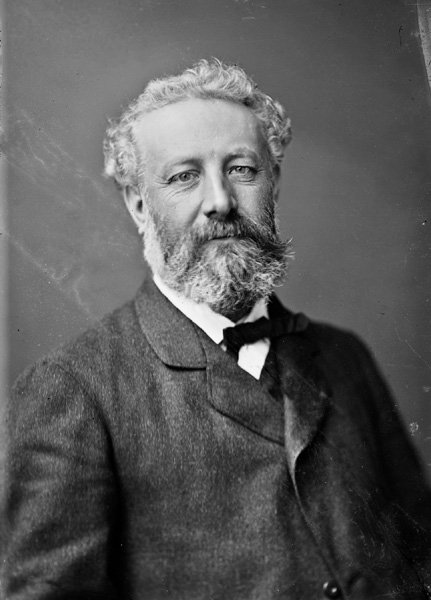 It was this world-famous French author, whose books have been translated into numerous languages, that has become known as the father of science fiction. Even today, the works of Jules Verne are popular and some of his books have been turned into movies, such as his books, Twenty-Thousand Leagues Under the Sea and Journey to the Center of the Earth. In both of these books and in most of his other ones, Verne employs the use of vivid, scientific descriptions and technology that did not exist at the time his books were written. Such works of fiction fall into the genre known as science fiction, a genre pioneered by Jules Verne, who is known by many as the father of science fiction. Some might argue that H.G. Wells is also the father of science fiction. H.G. Wells started publishing his books in the 1890s, several decades after Jules Verne’s famous works (which were first published in the 1860s) appeared on bookshelves. Before H.G. Wells had penned his first published novel, Verne was taking his readers on strange adventures through uncharted territories and mysterious lands. His novel Twenty-Thousand Leagues Under the Sea, published in 1869, explored the mysterious and hidden world beneath the sea, in a submarine: a vehicle that did not exist in the 1860s. In his novel From the Earth to the Moon, Jules Verne takes the reader on a journey through outer space in a space capsule, to visit the moon: something that would happen roughly a century later.
 Unlike his other famous stories, which are more plausible, Jules Verne’s story about spelunking, Journey to the Center of the Earth, describes an underground cavern filled with a breathable atmosphere, huge mushrooms, a sea, dinosaurs, and giants. At the time of its creation, the geothermal gradient (the rate at which temperature increases with increasing depth in Earth’s interior) was not known and the technique of seismic reflection (the method of determining the density and type of material in the earth by means of creating an artificial seismic wave) had not been discovered yet. Today, the thought of sending such an expedition to the center of the earth is laughable and absurd, but not in Verne’s time. Despite breaking some scientific facts, Journey to the Center of the Earth still remains a well-read classic to this day. One might say, without making an overstatement, that Jules Verne was truly a creative genius who had a visionary and inventive mind that baffles us today with its phenomenal ingenuity and foresight.
 His creative mind came up with ideas never thought of or penned down before: ideas which exist today as actual inventions. In an article titled In the Year 2889, published in 1889, he wrote about the future where people regularly communicated via a device that resembles the modern equivalent of video conferencing, where two or more parties can both see and hear each other live through computer or television screens. In this same article, Verne described a form of news that could be heard instead of read. Voices would replace newspaper print. This article was written several years before the first wireless transmission was made. It was on July 27, 1896 that the Italian inventor, Guglielmo Marconi, demonstrated to a small crowd wireless telegraphy for the first time.
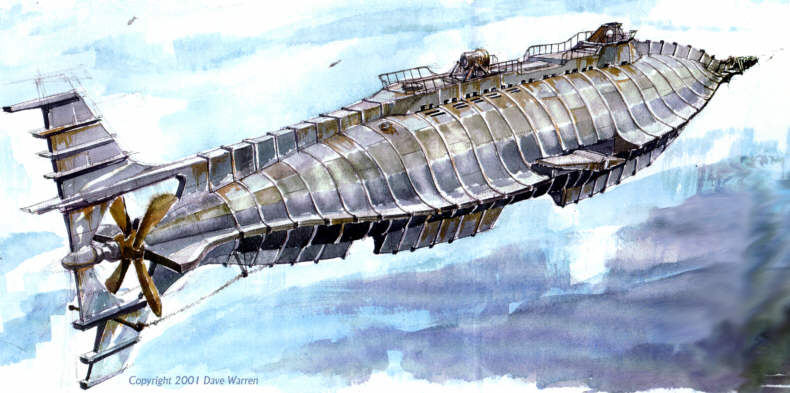
 Other fulfilled predictions Jules Verne has made include guns that can kill by means of electricity. In Twenty-Thousand Leagues Under the Sea, Captain Nemo’s men use guns that fire spheres charged with electricity. On impact, the projectiles release a lethal dose of electricity. A similar technology exists today, which is used by law enforcement officers. The Taser is a small device which can stun by sending electricity through a pair of electrodes that are fired into the skin of a person or animal. Another of Captain Nemo’s impressive devices is a backpack for breathing, used by Nemo’s divers. It was many decades later that the SCUBA tank was invented. But, the most profound technology described in Twenty-Thousand Leagues Under the Sea was the Nautilus, a submarine that ran on battery power. At the time Verne had written his story, no battery-powered submarines existed.
 Besides his accurate predictions about underwater technology, Jules Verne has also made stunning predictions about space travel. In his book From the Earth to the Moon, first published in 1865, Cape Canaveral is the launching place for the first manned mission to the Moon, and a bullet-shaped space capsule is fired from a huge cannon. The space travelers, who occupy this capsule, orbit around the Moon and return to Earth. In a manner similar to how the Apollo 11 capsule landed in the Atlantic, their pod splashes down in the ocean. An interesting fact is that it was 104 years after Verne’s book was first published that Apollo 11 was launched, in 1969.
 This incredibly accurate ability of Verne to predict the future is not limited to his famous works. One of Jules Verne’s books, which has been in hiding for 131 years, was published for the first time in 1994. Well ahead if its time, Paris in the Twentieth Century is a story that includes descriptions of glass skyscrapers, gasoline-powered cars, and fax machines. The story was set in the year 1960 and portrayed a dystopian world with technology similar to what exists today. Verne’s editor, Pierre-Jules Hetzel, rejected the story as being inferior to his previous work. Hetzel wrote to Verne, saying, “No-one today will believe your prophecy (Bernstein).”
It was years later that Jules Verne was considered to be a kind of prophet and a man ahead of his time. Few men alive then (or today) could have accurately imagined the future and put it into a fictional form. His books include numerous technological inventions, many of which have come true in one way or another. His vivid descriptions and heroic adventures make his stories come alive and contribute to his enduring popularity. His influence has rubbed off on subsequent authors and a new genre of fiction has been formed: science fiction. Jules Verne’s legacy—his amazing foresight, realistic descriptions, attention to science, and sense of adventure—has acted as a springboard for other authors to dive off of into the world of science fiction where the imagination is free to explore the mysteries of the universe in a way that is scientifically plausible.
It was years later that Jules Verne was considered to be a kind of prophet and a man ahead of his time. Few men alive then (or today) could have accurately imagined the future and put it into a fictional form. His books include numerous technological inventions, many of which have come true in one way or another. His vivid descriptions and heroic adventures make his stories come alive and contribute to his enduring popularity. His influence has rubbed off on subsequent authors and a new genre of fiction has been formed: science fiction. Jules Verne’s legacy—his amazing foresight, realistic descriptions, attention to science, and sense of adventure—has acted as a springboard for other authors to dive off of into the world of science fiction where the imagination is free to explore the mysteries of the universe in a way that is scientifically plausible.


