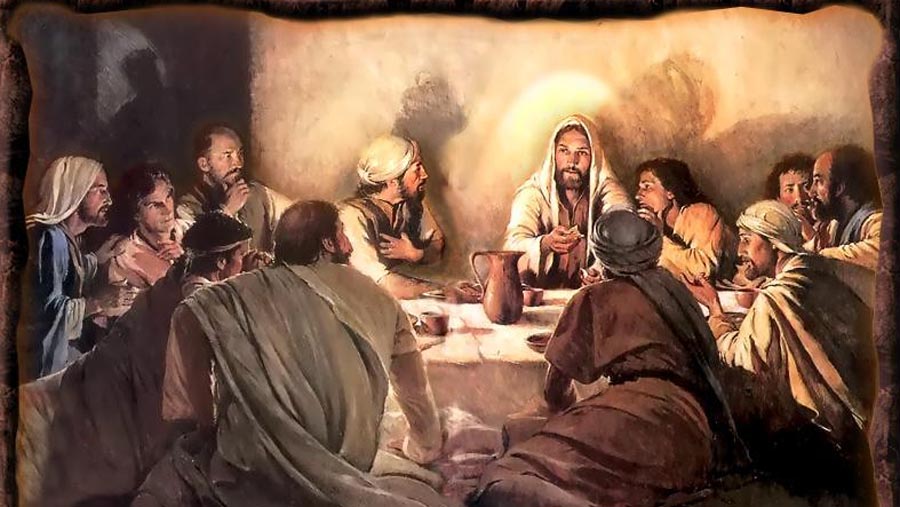
The Marriage Supper Parable - A Cartoon with Sound Effects, Music, and Scripture - A Teaching of Jesus in Matthew 22

(See the PDF file here: https://drive.google.com/file/d/1-l2aOUz80mv-LIyzzPpySegRgZDMaDLT/view?usp=sharing .) The Marriage...

Showing posts with label galatians. Show all posts

Thursday, November 16, 2017

The Father of the Prodigal Son (Luke 15) (God's Love) (God's Grace) (God's Compassion) (God's Forgiveness)

(The prodigal son and his father meet. Click for source.)

The Father of the Prodigal Son

I am writing this article as a Protestant who cares for Catholics and anyone who believes that it is necessary for them to perform for God's love or do works in order to be forgiven and cleansed from sin. 

Some people (both Protestants and Catholics) hold onto a wrong view of God that when they sin and repent, that somehow God would expect them to perform "penances," or acts to help pay for their sin, or works to bring them back to a "right standing" with God. Some believe they should confess their sins to a spiritual leader (such as a priest). But, what does the Bible say about this?


The Bible Has the Answer

(Bible. Click for source.)
James 5:16 says: "[16] Confess your faults one to another, and pray one for another, that ye may be healed. The effectual fervent prayer of a righteous man availeth much."

If someone has wronged you (such as spoken evil of you), he or she should confess that sin to you and ask your forgiveness. And, vice versa. This is not speaking about going to a person (or a priest) to confess one's sins to. If Jim gossiped about Bill, behind his back, he should confess his sin to Bill and ask for forgiveness. Likewise, Bill should do the same to Jim if Bill had mistreated Jim.

Friday, June 30, 2017

Expounding 2 Timothy 3:8-9 — False Teachers Exposed


Expounding 2 Timothy 3:8-9 — False Teachers Exposed [Print Document]

2 Timothy 3:8-9
“[8] Now as Jannes and Jambres withstood Moses, so do these also resist the truth: men of corrupt minds, reprobate concerning the faith. [9] But they shall proceed no further: for their folly shall be manifest unto all men, as theirs also was.”

In this article we are going to expound and discuss 2 Timothy 3:8-9. We will look at how the sorcerers of Egypt, who withstood Moses, are no different than false teachers who resist the truth. We shall see how God will have to deal with them and with those who follow them.


Jannes and Jambres

Let’s start with Jannes and Jambres, two of the sorcerers in Pharaoh’s court. (Note: The Old Testament doesn’t mention them by name, but the Jews knew who they were.)

Exodus 7:10-12
“[10] And Moses and Aaron went in unto Pharaoh, and they did so as the LORD had commanded: and Aaron cast down his rod before Pharaoh, and before his servants, and it became a serpent. [11] Then Pharaoh also called the wise men and the sorcerers: now the magicians of Egypt, they also did in like manner with their enchantments. [12] For they cast down every man his rod, and they became serpents: but Aaron's rod swallowed up their rods.”

These sorcerers decided to copy what God did through Moses and Aaron. But, God’s ways are higher than the devil’s, and the serpents of the sorcerers were eaten by the serpent that God had made from a stick. Jannes and Jambres were among these sorcerers and they used satanic power to mimic God. But, God showed His power is greater than the devil by having the serpent eat up the other serpents.

The devil and his servants mimic God, but they distort the truth. They hold a Bible in their hands and teach from it, but they twist the scripture to fit into their own unbiblical and ungodly belief system. They say, “God bless you” with their mouths, but they do not truly care about your soul or where you will end up after you die. They look good on the outside, but they are full of iniquity on the inside, in their hearts. Jesus said this about such people:

Matthew 23:27
“[27] Woe unto you, scribes and Pharisees, hypocrites! for ye are like unto whited sepulchres, which indeed appear beautiful outward, but are within full of dead men's bones, and of all uncleanness. [28] Even so ye also outwardly appear righteous unto men, but within ye are full of hypocrisy and iniquity.”

Thursday, June 29, 2017

Expounding 2 Corinthians 5:10 — The Judgment Seat of Christ


Expounding 2 Corinthians 5:10
— The Judgment Seat of Christ [Print Document]


2 Corinthians 5:10
“[10] For we must all appear before the judgment seat of Christ; that every one may receive the things done in his body, according to that he hath done, whether it be good or bad.”


Many have heard about the judgment of unbelievers before God’s great, white throne (Revelation 20). But, probably fewer have heard of Christ’s judgment of believers. Before we go further, let’s stop and explain that Jesus Christ’s blood alone can save us from our sins and bring us into Heaven (Romans 5). Whatever good works we have done will mean nothing if we have not made Jesus Christ our Lord and Savior. Our good works are actually filthy rags, if we have not made Jesus our Lord and Savior.


Isaiah 64:6
“But we are all as an unclean thing, and all our righteousnesses are as filthy rags; and we all do fade as a leaf; and our iniquities, like the wind, have taken us away.”


As you may know, Jesus Christ came to take our sins upon Himself and die, and He rose from the dead on the third day, according to the scriptures that prophesied of Him (1 Corinthians 15:3-6). Jesus Christ makes us righteous by His blood that He shed (Romans 5).


The Judgment of a Christian


When a Christian dies, he (or she) will go to Heaven and will stand before Jesus. When we enter Heaven, we will be embraced by Jesus. And, then, we will need to tell Him why we didn’t obey Him in certain areas of our lives, if we had resisted Him. We will not have to answer for sin that we confessed and forsook, but we will have to give account for sin we did not confess and forsake that He convicted us about.


1 John 1:9 says: “If we confess our sins, he is faithful and just to forgive us our sins, and to cleanse us from all unrighteousness.”

Tuesday, June 27, 2017

Expounding Colossians 2:8-9


Expounding Colossians 2:8-9 [Print Document]

Colossians 2:8-9
“[8] Beware lest any man spoil you through philosophy and vain deceit, after the tradition of men, after the rudiments of the world, and not after Christ. [9] For in him dwelleth all the fulness of the Godhead bodily.”

Paul, the apostle, wrote about men who would take people by way of carnal reasoning and worthless deception (which is not based on God’s Word). They will mislead people about Who Jesus Christ is and about what He said.


“Beware lest any man spoil you…”


Let’s look into the meanings of some words. The Greek word for spoil is esomai. It means: “may have” as in: ‘He may have that item.’ Spoil is defined by Webster’s 1828 dictionary as: “1. To plunder;...” [and] “2. To seize by violence; to take by force; …” [and] “4. To corrupt; to vitiate; to mar.” (Note: Vitiated means: “Depraved; rendered impure; rendered defective and void.” [Webster’s 1828 dictionary])

Paul is saying that false teachers can take you or seize you, with the idea of corrupting you, by way of their philosophies and deception.


“...lest any man spoil you through philosophy and vain deceit...”


In Greek, philosophy is called philosophia. It refers to the love of wisdom (i.e. worldly wisdom). Philosophy is defined by Webster’s 1828 dictionary as: “3. Reasoning; argumentation.” The philosophies false teachers promote are really just their carnal reasoning, which is contrary to God’s Word (See Romans 8:5-8).

Monday, June 19, 2017

Galatians Chapter 5, Verse 1 — False Grace Vs. True Grace (Part 2 of 2) (Short Version)


Galatians Chapter 5, Verse 1 — False Grace Vs. True Grace (Part 2 of 2) (Short Version) [Print Document]

 "Eternal Security" — Is This True?


Galatians 5:1
“[1] Stand fast therefore in the liberty wherewith Christ hath made us free, and be not entangled again with the yoke of bondage.”

In the first part of this two-part article, we discussed how some Church leaders and teachers say, or strongly imply, that God’s liberty or grace is all that God has for Christians, even when they live in sin.

We laid the foundation, from Romans 5, for what grace is and how Abba Father God showed us His love by sending Jesus Christ to die on the cross to pay for the penalty of our sins. And, we looked at Romans 6:16 and saw how one can actually become a servant of sin if he (or she) yields himself to serve sin.

Many teachers have taught that once you are saved from sin through Jesus Christ, you are always saved. They call this "eternal security." But, is this biblically sound? Does the Bible actually teach that born-again Christians can never fall away? We will examine this teaching in this second part of our article on Galatians 5:1.

Now, we will continue with Romans 6:16.

Galatians Chapter 5, Verse 1 — False Grace Vs. True Grace (Part 1 of 2) (Short Version)


Galatians Chapter 5, Verse 1 — False Grace Vs. True Grace (Part 1 of 2) (Short Version)
[Print Document]


Galatians 5:1
“[1] Stand fast therefore in the liberty wherewith Christ hath made us free, and be not entangled again with the yoke of bondage.”

Today, there are many teachers that say or imply through their sermons that God’s grace (or liberty) is the whole of the Gospel. They ignore the fact that without a justice system, which requires there be a penalty for rebellion against God, sin would increase and would only grow like yeast rising through dough.

They ignore the truth that if Christians continue living in sin, they would be resisting (i.e. hardening of the heart) God's conviction to repent from sin (Hebrews 3). They ignore the truth that the wages of sin is death (Romans 6:23), which is not just physical death.


Mark 9 and Removing the Offense


They also ignore the truth that Jesus Christ told His 12 disciples (Mark 9:33,47-48) that if something leads them into sin, they must get rid of it, lest they be hardened through sinning, and be cast into the fires of Hell. In Mark 9, Jesus said:


[Mark 9:47-48]

"[47] And if thine eye offend thee, pluck it out: it is better for thee to enter into the kingdom of God with one eye, than having two eyes to be cast into hell fire: [48] Where their worm dieth not, and the fire is not quenched." To give you the context, verse 33 shows how Jesus was speaking to His disciples in a house. Earlier, they had argued about who would be the greatest among them. That is when Jesus instructed them to become like a child (in humility and faith) and to forsake sin. In Mark 9:33, we read: "And he came to Capernaum: and being in the house he asked them, What was it that ye disputed among yourselves by the way?" As we saw in verse 47, Jesus taught His disciples that if something offends them, they must get rid of it, lest they be cast into hell fire. The word for offend is skandalizó in Greek, and it means "to entice to sin" (Thayer's Greek Lexicon). According to Webster's 1828 dictionary, "offend" means: "7. To draw to evil, or hinder in obedience; to cause to sin or neglect duty." So, Jesus, in essence, is telling His disciples that if, in the future, they go after something that leads them into sin, and do not forsake it, they would be cast into hell fire. This is crucial doctrine that the Church is missing in sermons, Bible studies, and Christian books.


The Foundation of God’s Grace

Sunday, June 18, 2017

Galatians Chapter 5, Verse 1 — False Grace Vs. True Grace (Part 2 of 2) (Long Version)


Galatians Chapter 5, Verse 1 — False Grace Vs. True Grace (Part 2 of 2) [Print Document]

 "Eternal Security" — Is This True?


Galatians 5:1
“[1] Stand fast therefore in the liberty wherewith Christ hath made us free, and be not entangled again with the yoke of bondage.”

In the first part of this two-part article, we discussed how some Church leaders and teachers say, or strongly imply, that God’s liberty or grace is all that God has for Christians, even when they live in sin.

We laid the foundation, from Romans 5, for what grace is and how Abba Father God showed us His love by sending Jesus Christ to die on the cross to pay for the penalty of our sins. And, we looked at Romans 6:16 and saw how one can actually become a servant of sin if he (or she) yields himself to serve sin.

Many teachers have taught that once you are saved from sin through Jesus Christ, you are always saved. They call this "eternal security." But, is this biblically sound? Does the Bible actually teach that born-again Christians can never fall away? We will examine this teaching in this second part of our article on Galatians 5:1.

Now, we will continue with Romans 6:16.


Expounding Romans 6:16


Romans 6:16 says: “[16] Know ye not, that to whom ye yield yourselves servants to obey, his servants ye are to whom ye obey; whether of sin unto death, or of obedience unto righteousness?”

The result of sin, when it is not dealt with by repentance from sin (which is forsaking sin), is death, and not righteousness. So, this verse in Romans is saying that sinning, and not forsaking sin, will produce death?

That is exactly what it and other verses in the Bible actually teach. Many teachers today ignore the plain meaning of the verses, or don’t teach them at all.

But, what kind of death are we talking about? Is it just physical death? Let’s look at Hebrews 10:26-30. It says:

Hebrews 10:26-30
“[26] For if we sin wilfully after that we have received the knowledge of the truth, there remaineth no more sacrifice for sins, [27] But a certain fearful looking for of judgment and fiery indignation, which shall devour the adversaries.

Galatians Chapter 5, Verse 1 — False Grace Vs. True Grace (Part 1 of 2) (Long Version)


Galatians Chapter 5, Verse 1 — False Grace Vs. True Grace (Part 1 of 2) [Print Document]


Galatians 5:1
“[1] Stand fast therefore in the liberty wherewith Christ hath made us free, and be not entangled again with the yoke of bondage.”

Today, there are many teachers that say or imply through their sermons that God’s grace (or liberty) is the whole of the Gospel. They ignore the fact that without a justice system, which requires there be a penalty for rebellion against God, sin would increase and would only grow like yeast rising through dough.

They ignore the truth that if Christians continue living in sin, they would be resisting (i.e. hardening of the heart) God's conviction to repent from sin (Hebrews 3). They ignore the truth that the wages of sin is death (Romans 6:23), which is not just physical death.


Mark 9 and Removing the Offense


They also ignore the truth that Jesus Christ told His 12 disciples (Mark 9:33,47-48) that if something leads them into sin, they must get rid of it, lest they be hardened through sinning, and be cast into the fires of Hell. In Mark 9, Jesus said:


[Mark 9:47-48]

"[47] And if thine eye offend thee, pluck it out: it is better for thee to enter into the kingdom of God with one eye, than having two eyes to be cast into hell fire: [48] Where their worm dieth not, and the fire is not quenched." To give you the context, verse 33 shows how Jesus was speaking to His disciples in a house. Earlier, they had argued about who would be the greatest among them. That is when Jesus instructed them to become like a child (in humility and faith) and to forsake sin. In Mark 9:33, we read: "And he came to Capernaum: and being in the house he asked them, What was it that ye disputed among yourselves by the way?" As we saw in verse 47, Jesus taught His disciples that if something offends them, they must get rid of it, lest they be cast into hell fire. The word for offend is skandalizó in Greek, and it means "to entice to sin" (Thayer's Greek Lexicon). According to Webster's 1828 dictionary, "offend" means: "7. To draw to evil, or hinder in obedience; to cause to sin or neglect duty." So, Jesus, in essence, is telling His disciples that if, in the future, they go after something that leads them into sin, and do not forsake it, they would be cast into hell fire. This is crucial doctrine that the Church is missing in sermons, Bible studies, and Christian books.


The Foundation of God’s Grace

Saturday, June 17, 2017

Expounding Galatians Chapter 5, Verse 1 ― Stand Fast in the Liberty (Part 2 of 2)


Expounding Galatians Chapter 5, Verse 1 ― Stand Fast in the Liberty (Part 2 of 2)

[Print Document]

(Read part 1 here.)

Galatians 5:1
“[1] Stand fast therefore in the liberty wherewith Christ hath made us free, and be not entangled again with the yoke of bondage.”

This is the second part of our article expounding Galatians 5:1. In the first part we learned about what God’s grace is, and what it isn’t. We saw how false teachers, mentioned in 2 Peter 2, would teach excessively about grace (or liberty), and ignore the teaching about true repentance from sin.

In this article, we will see how Aaron, out of fear of the people (i.e. peer pressure), compromised his standards and built an idol for the people. And, we will see how false teachers are building golden calves of false doctrines, which are destructive to those deceived by them.


The Golden Calf


In Deuteronomy 9, Moses was speaking to the Israelites that had come through 40 years of wandering in the wilderness. Moses reminded them of the golden calf that they worshiped after he had gone up to Mount Sinai. Listen to what he said:

Deuteronomy 9:9-12
“[9] When I was gone up into the mount to receive the tables of stone, even the tables of the covenant which the LORD made with you, then I abode in the mount forty days and forty nights, I neither did eat bread nor drink water:

[10] And the LORD delivered unto me two tables of stone written with the finger of God; and on them was written according to all the words, which the LORD spake with you in the mount out of the midst of the fire in the day of the assembly.

[11] And it came to pass at the end of forty days and forty nights, that the LORD gave me the two tables of stone, even the tables of the covenant. [12] And the LORD said unto me, Arise, get thee down quickly from hence; for thy people which thou hast brought forth out of Egypt have corrupted themselves; they are quickly turned aside out of the way which I commanded them; they have made them a molten image.”

After Moses went up to the mount, the people began to remember the idols of Egypt. Many of them did not desire God. The reason many came up with Moses was to escape the bondage of slavery in Egypt, but not really to serve God. Their hearts were not really toward God. When their spiritual leader left to get the Ten Commandments, and had been gone for over a month, they began to speak of building and worshiping a golden idol.

Exodus 32:1 ― “[1] And when the people saw that Moses delayed to come down out of the mount, the people gathered themselves together unto Aaron, and said unto him, Up, make us gods, which shall go before us; for as for this Moses, the man that brought us up out of the land of Egypt, we wot not what is become of him.”


Aaron Built the Golden Calf (but Later Repented)


Expounding Galatians Chapter 5, Verse 1 ― Stand Fast in the Liberty… (Part 1 of 2)


Expounding Galatians Chapter 5, Verse 1 ― Stand Fast in the Liberty... (Part 1 of 2)

[Print Document]


 Galatians 5:1
“[1] Stand fast therefore in the liberty wherewith Christ hath made us free, and be not entangled again with the yoke of bondage.”

The very first words we read in Galatians chapter 5 give Christians a command to stand fast in the liberty purchased by Jesus at the cross of Calvary. What is this liberty from? Is is liberty from the Levitical laws of the Old Testament, such as burnt sacrifices and offerings, observing feast days, not eating pork, etc.? Indeed, Jesus fulfilled the law, and purchased our redemption at Calvary. But, what kind of liberty is God giving us in Galatians 5:1? Is it the liberty to live for selfish reasons?

God does give us liberty from the Old Covenant of works, such as the Levitical laws and duties. God does give us grace each moment so that we can live in fellowship with Him, and not be under the bondage of sin. God’s grace gives us the power to overcome sin and to triumph over it, not be overcome by it (1 Cor. 15:56-57).

Sin itself is made strong by the law, but when we give place to sin, God has grace so that we can be forgiven and turn back to Him.
Romans 5:20-21
“[20] Moreover the law entered, that the offence might abound. But where sin abounded, grace did much more abound: [21] That as sin hath reigned unto death, even so might grace reign through righteousness unto eternal life by Jesus Christ our Lord.”

Grace ― What It Is and What It Isn’t

Thursday, June 15, 2017

Expounding the Meaning of Deuteronomy 10:8 (PART 3 of 3)


Expounding the Meaning of Deuteronomy 10:8 (PART 3 of 3) [Print Document]

This is the third part of a short series on expounding the meaning of Deuteronomy 10:8. There is a lot of depth in this verse that Abba Father God put on my heart to read.

In part 1 of this series, we looked at how bearing the Ark of the Covenant means that we are bearing God’s holy Word (which is based on the Ten Commandments) in our heart. We do this by meditating on God’s Word and by delighting in it (Psalm 1:2). In part 2, we learned how one ministers to God. We discussed what ministering to God is, and what it isn't. And, we learned that it is about fellowship with Abba Father God (Galatians 4:6-7), and not just doing works.

In this part (part 3), we will discuss and expound on what it means to “... bless in his name, unto this day.”

Deuteronomy 10:8, says: “At that time the LORD separated the tribe of Levi, to bear the ark of the covenant of the LORD, to stand before the LORD to minister unto him, and to bless in his name, unto this day.”


How to Bless in God’s Name


God separated us from the world so that we may “...bless in his name, unto this day.” What does this mean, though? God showed me that blessing in His Name includes praising God, giving Him glory, and speaking blessings over people with the leading of the Holy Spirit.

Let’s look first at praising God. What does praising God look like? King David gave us an example of praising God and giving God the glory in Psalm 103.

Psalm 103:1-5

“[1] Bless the Lord, O my soul: and all that is within me, bless his holy name.

[2] Bless the Lord, O my soul, and forget not all his benefits: [3] Who forgiveth all thine iniquities; who healeth all thy diseases; [4] Who redeemeth thy life from destruction; who crowneth thee with lovingkindness and tender mercies; [5] Who satisfieth thy mouth with good things; so that thy youth is renewed like the eagle's.”

David is speaking of what Abba God had done for him (and also for us). He is thanking God for His mercy and goodness. When we go through a difficult time (and I need to be reminded of this), we need to look to the holy Scripture for inspiration. David praised God even when he was going through difficulty, but after he first gave his troubles to God.


Praising God Even in the Difficulties


We we go through difficulties, we find it hard to praise God for what He will do or for what He already has done for us. It is often hard to thank Him when times get tough. But, David wrote that we ought to cast our burdens on God because God cares for us and will sustain us. In the beginning of Psalm 55, David wrote:

[Psalm 55:4-5]
“[4] My heart is sore pained within me: and the terrors of death are fallen upon me. [5] Fearfulness and trembling are come upon me, and horror hath overwhelmed me.”

After describing how a former friend betrayed him, David writes:

[Psalm 55:22]
“Cast thy burden upon the Lord, and he shall sustain thee: he shall never suffer the righteous to be moved.”

Casting our burdens on God is just talking to our loving Abba Father God about our problems and giving them into His caring hands. 1 Peter 5:6-7 says: “[6] Humble yourselves therefore under the mighty hand of God, that he may exalt you in due time: [7] Casting all your care upon him; for he careth for you.”
 
Once we have done that, we are more free inside to give God praise for what He will do and for what He has already done for us. This honors and pleases Him. But, don’t let this become a legalistic system of performing for God’s love. Abba God loves us with everlasting love (Jeremiah 33:3). Now, since God loves us so much, we “... ought also to love one another.”

1 John 4:11-12
“[11] Beloved, if God so loved us, we ought also to love one another. [12] No man hath seen God at any time. If we love one another, God dwelleth in us, and his love is perfected in us.”


Blessing Other People Honors God.