The Marriage Supper Parable - A Cartoon with Sound Effects, Music, and Scripture - A Teaching of Jesus in Matthew 22

(See the PDF file here: https://drive.google.com/file/d/1-l2aOUz80mv-LIyzzPpySegRgZDMaDLT/view?usp=sharing .) The Marriage...

Showing posts with label sorcery. Show all posts

Friday, June 14, 2019

STAR WARS CONTRADICTS THE BIBLE AND IS ANTI-CHRIST


STAR WARS IS ANTI-CHRIST


(The Devil's Tool to Steal the Hearts of Christians)


||  STAR WARS CONTRADICTS
THE BIBLE AND IS ANTI-CHRIST  ||


Released to the world in 1977, Star Wars became a powerful phenomenon which drew millions of people into its profound influence. But, its power to captivate the minds, imaginations, and hearts of countless millions of people is not something that can be lightly ignored. Christians need to be aware of the messages and themes in Star Wars, especially since the Bible warned us about deceivers and evil people who would conduct amazing signs and wonders to deceive, if possible, God's people. 

The darkness in our world is increasing. We must be vigilant, as Christians, to watch and pray ... that is we need to know what God would show us personally and to pray as God leads us by His Holy Spirit. In the dark waters of this world, we need God's Holy Spirit and His Holy Bible to guide us when we consider the popular things in our culture and world.


Monday, June 12, 2017

Lord of the Rings Exposed - The Inklings and the Occult (J.R.R. Tolkien, C.S. Lewis, and Charles Williams)


Lord of the Rings Exposed - The Inklings and the Occult (J.R.R. Tolkien, C.S. Lewis, and Charles Williams)
Now posthumously famous around the world, J.R.R. Tolkien and C.S. Lewis have had a huge impact on our modern culture. Many video games, fantasy novels, and role-playing games (including Dungeons and Dragons) have been strongly influenced by The Lord of the Rings [A]. Gary Gygax, the maker of Dungeons and Dragons, originally incorporated story elements from Lord of the Rings before changing these when the game was sold to the public [A]. Tolkien, Lewis, and other Oxford professors and writers, together, formed a small group known as the "Inklings." They would meet together to discuss literature and read aloud their fiction manuscripts. We will now look at one "Inkling" in particular.
Charles Williams
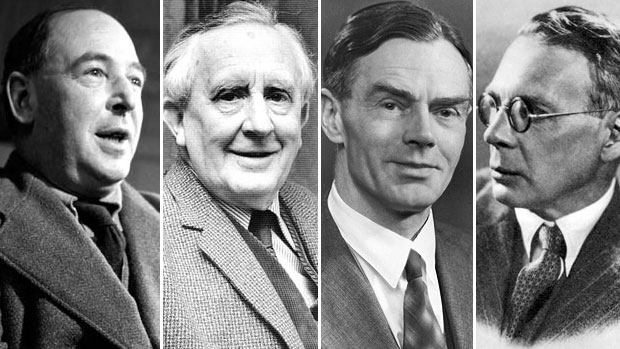
(Some of the "Inklings" including Lewis,
Tolkien, Owen Barfield, and Charles Williams)
A man you may not have heard of befriended J.R.R. Tolkien and C.S. Lewis, and played an important a role in influencing their writing. His name was Charles Williams, an esoteric author of novels, poems, and nonfiction works. What makes him an interesting character is his fascination with the occult. At the age of about 30, Williams joined a secret society that focused on occult rituals, ‘magick,’ and gnostic teachings.

Humphrey Carpenter wrote about Williams’s initiation (in 1917) into an esoteric, secret society called the Hermetic Order of the Golden Dawn [B]. From Carpenter’s book, The Inklings: C. S. Lewis, J. R. R. Tolkien and Their Friends, we read:

"Among its first initiates was a coroner who allegedly performed necromantic rites... while another early member was black magician Aleister Crowley, the self styled Great Beast.... But the Order of the Golden Dawn also included persons of less outlandish ways, such as W. B. Yeats, … A. E. Waite ....  It was this group that Williams joined.” [B.] [End quote]

Sunday, June 11, 2017

Lord of the Rings Exposed ─ Gandalf the Wizard and Tolkien the Master of Deception (Is Lord of the Rings Occultic?)


Lord of the Rings Exposed ─ Gandalf the Wizard and Tolkien the Master of Deception (Is Lord of the Rings Occultic?)


In this article, we will look at some of the symbols and messages
in some of Tolkien's LOTR books and writings. We will see if they are occultic, or not. 
We'll look at the "Doors of Durin", the White Tree of Gondor, Gandalf's true identity as
one of the Istari, and more.

Many have researched into occult aspects of various books and movies. Some have pointed out actual witchcraft portrayed for entertainment in fictional books and movies, such as Star Wars and Harry Potter. The occult world is very active in these days in which we live. But, are J.R.R. Tolkien’s Lord of the Rings novels free of anything occultic? Or, do they include occult themes and symbols?

To answer those questions, we’ll start with an important character in The Hobbit and The Lord of the Rings. Gandalf is a wizard who demonstrates magical power through spells and by use of his staff. But, according to J.R.R. Tolkien, Gandalf is not a human being. Tolkien described Gandalf in this way:

“But G. [sic] is not, of course, a human being (Man or Hobbit). There are naturally no precise modern terms to say what he was. I wd. [sic] venture to say that he was an incarnate 'angel'... that is, with the other Istari, wizards, 'those who know', an emissary from the Lords of the West, sent to Middle-earth, as the great crisis of Sauron loomed on the horizon. By 'incarnate' I mean they [the Istari / wizards] were embodied in physical bodies capable of pain, and weariness, and of afflicting the spirit with physical fear, and of being 'killed', though supported by the angelic spirit they might endure long, and only show slowly the wearing of care and labour. ...” [A.] [End quote] (underline added)

Tolkien described Gandalf (and the other the Istari wizards) as having a physical body that suffers from weariness and pain, but that is controlled by an angelic spirit. Thus, Gandalf was an “incarnate angel”. Half man, half angel creatures are found in Genesis chapter 6.


Genesis 6 and the Fallen Angels

Friday, June 9, 2017

The Lord of the Rings Exposed - Elves, Dwarves, Goblins, Trolls, Fairies, and Wizards (What Are They? Do They Exist or Did They Exist at One Time?)


The Lord of the Rings Exposed - Elves, Dwarves, Goblins, Trolls, Fairies, and Wizards (What Are They? Do They Exist or Did They Exist at One Time?)

In The Lord of the Rings and The Hobbit (and Narnia), we read about dwarves, trolls, goblins, elves, and other mythical creatures. These creatures have been featured in myths going back thousands or hundreds of years. J.R.R. Tolkien drew from these myths to write his famous Lord of the Rings series and associated books. But, are these creatures only found in fantasy and myths?


What Is a Dwarf?

I did a Google search and found a book by a Wiccan describing, in a matter-of-fact way, how a witch (or Wiccan) could summon various spirit creatures, such as gnomes, dwarves, elves, and others. Listen to what Mr. Skye Alexander writes concerning gnomes and dwarves:

‘Gnomes, whose name means “earth dwellers,” dwell in the element of earth. …. At times, however, they can seem gruff… Sometimes called trolls or leprechauns, these elementals are practical, no-nonsense,... creatures. They … can be valuable aides when you’re doing prosperity spells. Other earth spirits include the dwarves of European faery tales [sic], the bergbui (Teutonic mountain giants), the kubera (Hindu guardians of the north), and the simargl (Slavic guardians of all plants). If you wish to work with a gnome, go to a wooded area, call to it, and wait patiently until it reveals itself to you or you sense its presence.”’ [A.] [End quote] (underlining added)

If you are familiar with the Bible, you will know that God forbids communicating with familiar spirits in Deuteronomy 18.

Deuteronomy 18:10-11
“[10] There shall not be found among you any one that maketh his son or his daughter to pass through the fire, or that useth divination, or an observer of times, or an enchanter, or a witch, [11] Or a charmer, or a consulter with familiar spirits, or a wizard, or a necromancer.”

It is strange to most people, but Wiccans (“white” witches) actually communicate with spirits they call dwarves, elves, fairies, gnomes, etc.

What Are Fairies and Elves?

Monday, June 5, 2017

Lord of the Rings — The Witchcraft of Lord of the Rings Exposed (and The Hobbit)


Lord of the Rings — The Witchcraft of Lord of the Rings Exposed (and The Hobbit)


What is the reason that so many Christians like The Lord of the Rings and The Hobbit? Why do so many Christians take their children to watch Lord of the Rings movies, and let their older children read the books? 

They might say it is fantasy or pretend. But, is the magic portrayed in these books (and films) just pretend? This article will take you into some scenes from The Hobbit to explore these questions and to reveal truth about these subjects you may not be aware of.

__________________

Popular since the time they were written, The Lord of the Rings and The Hobbit have drawn millions of fans across the globe. They tell the story of Bilbo and Frodo, two hobbits that both set out on magical adventures in the world of Middle Earth. Both had at one time carried a magic ring of power. Both used it to disappear, and hide from danger.

A wizard named Gandalf helped and befriended them. His friendship and influence make these stories what they are. They would not exist without this character. Parents, I write to you, since you have the responsibility to teach your children what is right and true. Children for several decades have been taught ideas and concepts through The Lord of the Rings and The Hobbit.

We need to address these ideas and concepts, removing personal bias and beliefs to see them from the standpoint of truth vs. opinion. We will ask and try to answer the questions: ‘Are The Lord of the Rings and The Hobbit occultic? If so, how?’

In 1937, It All Began


In 1937, J.R.R. Tolkien, author of The Lord of the Rings and its companion The Hobbit, introduced us to a wizard character named Gandalf in his first book featuring Gandalf — The Hobbit. Tolkien introduces us to this benevolent wizard in this way:

“All that the unsuspecting Bilbo saw that morning was an old man with a staff. He had a tall pointed blue hat, a long grey cloak, a silver scarf over which his long white beard hung down below his waist, and immense black
Boots.” [1]

When Galdalf meets Bilbo Baggins, we read:

“Yes, yes, my dear sir—and I do know your name, Mr. Bilbo Baggins. And you do know my name, .... I am Gandalf, …. ”

“Gandalf, Gandalf! … Not the wandering wizard that gave Old Took a pair of magic diamond studs that fastened themselves and never came undone till ordered? Not the fellow who used to tell such
wonderful tales at parties, about dragons and goblins ...?” [1]

We to look at something deeper. In this short portion of the book, we learn that magic was used to fasten diamond studs. They were only unfastened by speaking a word, a command. That spoken word is a magic spell. This story was originally written for children. What kind of messages does J.R.R. Tolkien’s books bring to children? Are Lord of the Rings and The Hobbit innocent fantasy, or do they teach harmful ideas? We will address these questions in this article.

The Number of Times Certain Words Appear in The Hobbit


In The Hobbit (according to a word search box), the word “wizard” appears 69 times. The word “magic” appears 34 times. “Wand” or “staff” (i.e. magic wand / staff) together appear 10 times. “Spell” (as in a magic spell) can be found in 6 different places. The phrases “magic ring,” “the ring,” “a ring of power,” “his ring,” and “a ring” (i.e. in the context of the magic ring) together appear about 37 times (in the text of Tolkien’s book).

Bilbo Baggins Finds the Ring.


Saturday, June 3, 2017

The Occult in Narnia, Part 6 - The Magician's Nephew Promotes the Occult

The Occult in Narnia, Part 6 - The Magician's Nephew Promotes the Occult


The story called The Magician's Nephew was set by C.S. Lewis to be the first book in The Chronicles of Narnia, even though he wrote it some years after The Lion, the Witch, and the Wardrobe. This story has a boy named Digory and a girl named Polly travelling to alternate universes by way of magic rings -- rings that his uncle Andrew obtained. Andrew Ketterley, a sorcerer (magician), offered a yellow, magic ring to Polly, Digory's neighbor girl. She vanished into thin air and arrived at another world, in an alternate universe. 

Seeing a greedy look flash on his uncle's face, Digory had warned Polly not to touch the yellow rings, which were in a tray. C.S. Lewis wrote:

"Polly! Don't be a fool!" he shouted. "Don't touch them."


It was too late. Exactly as he spoke, Polly's hand went out to touch one of the rings. And immediately, without a flash or a noise or a warning of any sort, there was no Polly. Digory and his Uncle were alone in the room." [1]

Let's stop here and address something that should be concerning to every parent. Magic rings that cause people to disappear are fictional. But, magic rings that can "control" an occult "force" are real. 

The Force and Witchcraft


The late David J. Meyer, a former witch, who left witchcraft and became a born-again Christian, wrote some articles exposing the occult in some popular books and films. Meyer explained what magic rings were used for by real witches:

"The first thing a neophyte or beginner witch is taught is that there is a “force.” The “force” has two sides and can be controlled by magic spells, words, potions, incantations, rope magic, rings, amulets, and so on. Witches believe that there is good witchcraft and bad witchcraft, and the good always triumphs over evil! Witches also teach that battles are fought in the Middle Earth and in the astral plane causing upheavals both above and below. Thus, witches emphasize that good must triumph over evil, but it is all witchcraft." [2] (emphasis added) 

Witches control the "force" by way of many items, including rings. Many movies and books, including Star Wars and Lord of the Rings, are very occultic. Using a ring to work magic is what witches do today. This is not a fictional concept. It is reality. The Bible forbids magic and the occult in Deuteronomy 18 and elsewhere.


The Magic Ring


Moving on, we will now look at how young Digory treated his uncle after Polly magically vanished from touching a ring. Keep in mind that Narnia was written by a man who claimed to be a Christian. Digory confronts his uncle about sending Polly to an alternate universe. C.S. Lewis writes:

[Andrew said:] "...The whole point of sending anyone into the Other Place is that I want to find out what it's like."

"Well why didn't you go yourself then?"

"Digory had hardly ever seen anyone look so surprised and offended as his Uncle did at this simple question. "Me? Me?" he exclaimed. "The boy must be mad! A man at my time of life, and in my state of health, to risk the shock and the dangers of being flung suddenly into a different universe? ... Do you realise what you're saying? Think what Another World means—you might meet anything—anything."


"And I suppose you've sent Polly into it then," said Digory. His cheeks were flaming with anger now. "And all I can say," he added, "even if you are my Uncle—is that you've behaved like a coward, sending a girl to a place you're afraid to go to yourself."


"Silence, Sir!" said Uncle Andrew, bringing his hand down on the table. "I will not be talked to like that by a little, dirty, schoolboy. You don't understand. I am the great scholar, the magician, the adept, who is doing the experiment. Of course I need subjects to do it on. ... No great wisdom can be reached without sacrifice. But the idea of my going myself is ridiculous. It's like asking a general to fight as a common soldier. Supposing I got killed, what would become of my life's work?"


"Oh, do stop jawing," said Digory. "Are you going to bring Polly back?" [End quote] [1]

Notice how Digory treats his uncle. Is this book teaching children to respect others, especially their elders? Besides having this boy character not showing respect to adults, and giving him a bad attitude toward his uncle, C.S. Lewis is doing something else with this character. Digory represents children that do not like the idea of magic. In the story, Digory actually didn't believe magic existed, until he saw it with his own eyes. After he saw Polly vanish, and after some heated dialogue with his uncle, Digory said:

".... I didn't believe in Magic till to-day. I see now it's real. Well if it is, I suppose all the old fairy tales are more or less true. ..." [1]

In The Lion, the Witch, and the Wardrobe, Digory is the professor that Lucy and her siblings are staying with. He has a magic wardrobe that sends Lucy and her friends to Narnia. He went from being a skeptical child to believer in magic.

In The Voyage of the Dawn Treader, Eustace Clarence was presented to the reader as unlikable and stuck-up. He scoffed at the idea of magic being real. After his magical adventures in Narnia, Eustace was said to have "improved." C.S. Lewis writes: "...back in our own world everyone soon started saying how Eustace had improved, and how "You'd never know him for the same boy..."

Lewis makes the boy characters that are skeptical or uninterested in magic look unhappy and unlikable. Children that don't believe in magic are being slowly shaped by the Narnia books to believe that magic is actually real, or something that could be real. An appetite for a magical realm is what draws children into more and more overtly occultic fantasy. 


The Astral Plane


In witchcraft, the 'astral plane' is a hypothetical realm where spirits live and where other worlds are thought to exist. There are many views about what exists in this occultic concept of the supernatural world. Some believe there are planets populated by 'astral' beings. People that practice witchcraft and eastern meditation have said they travel to such worlds frequently. This practice is forbidden in the Bible, in Deuteronomy 18. 

It is a type of divination. Merriam-Webster defines divination as: "the art or practice that seeks to foresee or foretell future events or discover hidden knowledge usually by the interpretation of omens or by the aid of supernatural powers" [4]. Discovering "hidden knowledge" happens as a sorcerer supposedly 'travels on the astral plane.' When Lucy goes to Narnia, or Digory and Polly travel to the land of Charn, children are being taught that astral travel is 'good.' For, indeed, what they are really doing is astral travel. 

Deuteronomy 18:10-11 says: "[10] There shall not be found among you any one that maketh his son or his daughter to pass through the fire, or that useth divination, or an observer of times, or an enchanter, or a witch, [11] Or a charmer, or a consulter with familiar spirits, or a wizard, or a necromancer."

Aslan Promotes Magic


Aslan, the lion, who Lewis called a "supposal" of Christ [3], is also reinforcing in children's minds that magic is "neutral," and can be used for either "good" or "bad." C.S. Lewis writes:

Wednesday, May 31, 2017

The Real Witchcraft of Narnia Exposed - Narnia's Occult Agenda

The Real Witchcraft of Narnia Exposed - Narnia's Occult Agenda (Part 2)


In this short series, we will show facts about C.S. Lewis and his books that will challenge the belief many hold that ‘C.S. Lewis was a Christian author of good children’s stories and Christian books.’ Today, we will look at some of the occultic themes found in The Chronicles of Narnia. We will ask and answer the question: 'Is real witchcraft portrayed in C.S. Lewis' Narnia series?' 

In pre-medieval times, Europe was primarily made up of pagan tribes, such as the Celts, Goths, Picts, and others. These tribes often worshiped gods and goddesses, such as Thor, Oden, and Aine (a Celtic fertility goddess). People in ancient Europe often claimed to have seen supernatural beings appear in wooded areas and elsewhere. 


The Peterborough Chronicle is a historical account of England written during the Middle Ages, after the Norman Conquest of 1066. A supernatural event was reported to have been witnessed near the town of Peterborough. Through the woodland surrounding the town of Peterborough, large, hideous black creatures appeared, blowing horns, and many were riding black horses and he-goats. Read the actual account below:


"Many men both saw and heard a great number of huntsmen hunting. The huntsmen were black, huge, and hideous, and rode on black horses and on black he-goats, and their hounds were jet black, with eyes like saucers, and horrible. This was seen in the very deer park of the town of Peterborough, and in all the woods that stretch from that same town to Stamford, and in the night the monks heard them sounding and winding their horns." [1]

This account is one of many similar accounts of supernatural creatures making their appearance in what are called "wild hunts." As these events became more commonly known in Germanic lands, Scandinavia, Britain, and elsewhere, people included fairies in their retelling of the stories.


Jacques Vallee Reveals the True Nature of Aliens and Fairies 


Jacques Vallee, a well known UFO researcher, wrote in his book Passport to Magonia that from ancient times people have described encounters with fairies that seemed to have intercourse with human beings. Vallee compares demons with fairies in the same book:

"What we have here is a complete theory of contact between our race and another race, non-human, different in physical nature, but biologically compatible with us. Angels, demons, fairies, creatures from heaven, hell, or Magonia: they inspire our strangest dreams, shape our destinies, steal our desires......
But who are they?" [2]

The Bible reveals how a third of God's angels rebelled against Him, and became fallen angels that served Satan, who had been known as the angel Lucifer. Revelation 12 speaks of a great red dragon (Satan) who drew a third of the stars of heaven.
Revelation 12:3-4 a.
[3] And there appeared another wonder in heaven; and behold a great red dragon, having seven heads and ten horns, and seven crowns upon his heads. [4 a.] And his tail drew the third part of the stars of heaven, and did cast them to the earth: ..."

Isaiah 14:12 speaks how Lucifer (Satan) is fallen from Heaven. The prophecy says: "How art thou fallen from heaven, O Lucifer, son of the morning! how art thou cut down to the ground, which didst weaken the nations!" In Luke 10:18, Jesus said that He saw Satan fall from heaven. Luke 10:18 — "And he said unto them, I beheld Satan as lightning fall from heaven." Revelation 12 goes on to say how Satan was cast out of heaven with his angels.
Revelation 12:9 — "And the great dragon was cast out, that old serpent, called the Devil, and Satan, which deceiveth the whole world: he was cast out into the earth, and his angels were cast out with him."

These same evil spirits go forth seeking whom they may devour.
1 Peter 5:8-9 
[8] Be sober, be vigilant; because your adversary the devil, as a roaring lion, walketh about, seeking whom he may devour: [9] Whom resist stedfast in the faith, knowing that the same afflictions are accomplished in your brethren that are in the world.

These evil spirits can appear as angels of light to deceive men. 2 Corinthians 11:14 — "And no marvel; for Satan himself is transformed into an angel of light." They are deceivers and liars that make themselves appear like what they are not. If demons can appear as angels of light, why can't they appear as fairies, elves, leprechauns, dwarfs, trolls, monsters, dryads, nymphs, aliens, etc.?


Mr. Tumnus


In The Chronicles of Narnia, many of these magical creatures are seen, including satyrs or fauns, such as Mr. Tumnus, who helped Lucy in The Lion, the Witch, and the Wardrobe. One of the most well known fauns is the pagan god Pan. Like Pan, Mr. Tumnus appears as a half man, half goat creature. Pan is known for being a symbol of lust, immorality, and paganism. Disturbingly, Mr. Tumnus (the Pan look-alike) brings a little girl to his cottage. He offers her tea and plays music that enchants Lucy. Here's what C.S. Lewis wrote (from The Lion, the Witch, and the Wardrobe):

"Then to cheer himself up he [Mr. Tumnus] took out from its case on the dresser a strange little flute that looked as if it were made of straw and began to play.
And the tune he played made Lucy want to cry and laugh and dance
and go to sleep all at the same time. It must have been hours later when she shook herself..." [3] 

In the 2005 movie adaptation, this magic flute causes magical figures to appear, dancing in the flickering fireplace flames of the cottage. IMDB said of the faun's music: "He plays a hypnotic tune on a flute-like instrument, and Lucy actually sees shapes form in the flames of Tumnus' hearth fire, shapes of a man riding a unicorn, and fauns and dryads dancing." [4]. 


Aslan Verses the White Witch


The magic flute is just the starting point for more occultic elements that Lewis will put in his Narnia books. The very fact that a children's story is portraying an "evil" witch who has the power to put spells on an entire country to cause a perpetual winter is disturbing, knowing that real witches do exist today. Making a witch seem powerful and able to cause perpetual winter is not biblical because the devil does not have the power to do such a thing. The devil is the one behind all witchcraft. Satanists use a type of sorcery that knowingly requires the use of demons. The devil does not have the power to cause eternal winter or summer. But, in the Narnia world, this evil witch can cause everyone to suffer from the cold of winter.

Aslan, the lion character, appears on the scene to stop the evil witch and break her spell of winter. But, Aslan himself uses magic. The very way Lucy and her siblings arrived in Narnia was due to magic. But, in The Voyage of the Dawn Treader, a magic spell-book is used.