Did Ancient People Believe that Dinosaurs Were Contemporaries of Humankind?
Like cultures today, ancient people created artwork based on real-life subjects. Many cave paintings (pictographs) and petroglyphs (shallow rock carvings) depict scenes from battles (24), ancient people performing various rituals (36), (and fauna, such as buffalo, seen by the native peoples. Sculptures, mosaics, figurines, and carvings made by people hundreds or thousands of years ago also depict some strange creatures that seem to closely resemble what we might call dinosaurs. This leads to a fascinating question: Did ancient cultures believe that dinosaurs were contemporaries of humankind and did they claim to see such creatures?
The Acambaro Figurines
In the summer of 1944, a German merchant, Waldemar Julsrud, made a discovery that has caused a stir in the scientific community (35). It was July 1944 and Waldemar Julsrud was riding his horse along the lower slope of El Toro Mountain near the town of Acambaro, Mexico, when he noticed something unusual poking out of the dirt (35). Dismounting, he tore into the ground and unearthed a few ceramic objects unlike anything he had ever seen before (35). His discovery led to the excavation of over 33,500 ceramic, stone, and jade figurines and artifacts (35).
Charles Hapgood, a professor of anthropology and history at Keene State College, learned about the figurines and decided that he would see them for himself (35). After investigating and researching the figurines for 18 years, and after seeing more of the objects turn up when workers dug in certain locations he determined, Hapgood, a self-confessed skeptic (35), authored a book on the Acambaro figurines: Mystery in Acambaro: Did Dinosaurs Survive Until Recently? No longer a skeptic about the origin and authenticity of the ancient figurines, Charles Hapgood believes that they were made by an ancient culture. At the same place where the artifacts were discovered, the teeth of an extinct horse, the skeleton of a mammoth, and human skulls were also unearthed (35). The fact that many of these unique figurines resemble dinosaurs has been a reason the majority of the scientific community has ignored the discovery, passing it off as a hoax.
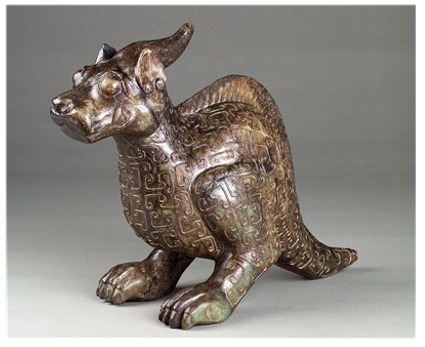
Shang Dynasty "Saurolophus"
Besides the major discovery in Acambaro, a number of other figurines from other ancient cultures have sparked debate or been ignored by the majority of the scientific community. An artifact from the Shang Dynasty is described by Genesis Park website as a creature that "displays relief lines in a scale-like pattern, a broad beak, a dermal frill, and a headcrest that is strikingly like the dinosaur Saurolophus ..." (1). According to Genesis Park, the dinosaur-like figure "was advertised on the Chinese antiquities market as a dinosaur depiction" (1). Concerning it's authenticity, Genesis Park declares that: "This jade statute, now in the Genesis Park collection, is made of white colored nephrite with differential weathering, cleaving veins and earth penetration, demonstrating authenticity …" (1).
Besides the Acambaro figurines and the Shang Dynasty saurolophus, there are more examples of possible dinosaur-like figurines from ancient cultures that could be mentioned such as the figurine of a Dogon tribesman, from Africa, riding a strange, "prehistoric" creature or the painted pots and vases from the Moche tribe of South America. According to Genesis Park, the Moche tribe ceramics display "with singular realism medical acts, combative events, musical instruments, plants and animals" (1). Some of these painted vases and pots have what appear to be realistic dinosaurs painted on their clay surfaces (1). The Moche tribe pottery collection is currently located in the Larco Herrera Museum in Peru (1).
The Ica Stones
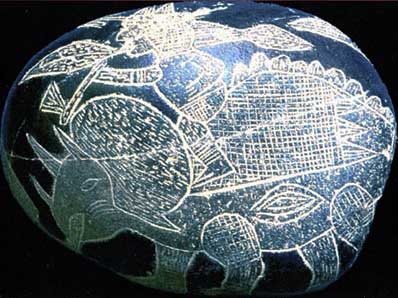
Besides clay, ancient humans used stone and metal to artistically record objects, events, or animals they had witnessed. They also carved images into individual rocks. An example of this can be found in the controversial Ica Stones discovered by Dr. Javier Cabrera outside of the town of Ica. Over the years, Dr. Cabrera had amassed a huge collection of stones with strange carvings in their surfaces depicting people and dinosaur-like creatures living together. Referring to Dr. Cabrera's collection, Josef F. Blumrich, a NASA scientist, said, "I am deeply impressed by what I have seen here, and I am happy to have found so much direct evidence of what I began to feel and understand before. There is not doubt in my mind about the authenticity of these stones" (10). Unfortunately, there is no way of scientifically determining whether or not the stones are ancient. Because of their controversial nature, Dr. Cabrera has received a lot of condescension by the scientific community (4).
The Granby Idol
A discovery made in 1920 by a rancher outside the town of Granby, Colorado bears the unique appellation "the Granby Idol". Bud Chalmers was removing rocks from his ranch one day when he lifted one that weighed more than he expected. Curious, he decided to wash it off. After the coating of dust and dirt had been removed, a set of grooves appeared in the rock. A crude, smiling face surrounded by strange symbols appeared on one side of the rock (22). On the reverse side of the stone, to Bud Chalmers amazement, the distinct carvings of a long-necked dinosaur and a woolly mammoth appeared (22). As an interesting note, Dr. Cyclone Covey, who wrote a book about the possibility that the ancient Chinese had come to America, studied photographs of the stone and identified the symbols carved into the stone as belonging to the ancient Chinese (22).
Mesopotamian Cylinder Seal
Another ancient artifact, created by carving into a stone chunk, that provides a clue that the ancients believed dinosaurs existed with them is a Mesopotamian cylinder seal, estimated to come from the year 3,300 B.C. (13). The seal displays two long-necked animals--that strikingly resemble modern renderings of a sauropod dinosaur--entwining their necks and tails. The shape of the muscles and length of the necks and tails of the creatures are remarkably realistic. One can only logically conclude that the artists who created the seal would have had to have seen either a representation of a dinosaur or a living specimen to make such an accurate depiction. The imagination alone could not produce such accuracy.
The Anasazi Dinosaur Petroglyph

Depictions of dinosaurs are not limited to figurines, stones, or cylindrical seals. Ancient dinosaur artwork has been found on cliff sides, on walls, and in buildings. Petroglyphs and pictographs made by ancient tribes depict strange creatures that do not match up with any that are known to exist today. In Natural Bridges National Monument, Utah, a very interesting petroglyph that resembles a sauropod (long-neck dinosaur) has raised eyebrows and questions. The petroglyph is attributed to the Anasazi Indians who lived in that area during the 1300s A.D. (15). Like the creators of the other relics mentioned above, the Anasazi Indians' ability to create such rock art could only be explained if the Anasazi Indians had actually seen a living dinosaur. The first complete dinosaur skeleton was discovered by William Parker Foulke in 1858, in Haddonfield, New Jersey (17). That is more than five-hundred years after the Anasazi Indian tribe left the area in which the dinosaur petroglyph was discovered.
The Water Panther Pictograms
Found on different cliff faces near the Great Lakes, another interesting native representation of a dinosaur-like creature draws the attention of curious hikers. The creature is called the water panther. The Sioux Indians believe that this creature inhabits the Missouri River. Vine Deloria, author of Red Earth, White Lies: Native Americans and the Myth of Scientific Fact, reports in his book what members of the Sioux tribe have said about the legendary creature. The creature had a backbone "just like a crosscut saw" and "in the middle of its forehead was one horn" (7). The pictograms of this creature show an animal with a jagged back similar to a dinosaur's back, and two horns protruding from its head. It looks strikingly like a triceratops, a member of the family Ceratopsidae, or a horned dinosaur of some kind.
Angkor Wat "Secret"

Representations of dinosaurs on large, flat surfaces are not limited to pictographs and petroglyphs on cliff sides. Some ancient buildings have eye-opening features either cut into or affixed to their walls and floors. One of the most clear examples of this can be found in the mysterious, ancient ruins of Angkor Wat. Richard Sobol, author of The Mysteries of Angkor Wat: Exploring Cambodia's Ancient Temple, wrote about his experience exploring the ancient temple. A group of kids he met wanted to show him a "secret" (29). They led him over to a rock wall filled with carvings. Richard Sobol writes, "I moved closer, and saw there, on the wall, carved inside a circle, a creature that could only be described as a dinosaur--a stegosaurus, in fact" (29). The image he took of the dinosaur, which is carved into a circle within the wall, resembles a stegosaurus. Whether or not it is a stegosaurus, it does have some of the distinct features of the family Stegosauridae: triangular plates on its back and tale, four muscular legs, a head attached to a short neck, a large body, and a thick tail.
The Tomb of Richard Bell
Another oddity is found in the tomb of a fifteenth-century bishop at Carlisle, Richard Bell. A brass fillet, dating back to the 1400s, runs around the perimeter of his tomb. Engraved into its metal surface are various animals such as a dog, a fish, an eel, a bird, a pig, etc (8). What is really intriguing is the engraving of what appear to be two long-necked creatures with long tails apparently struggling with each other. All the creatures in the tomb are fairly accurately portrayed, so it is most likely that these creatures were accurately portrayed as well (8). Having long necks, four legs, and thick, long tails, the creatures appear to be sauropods (8). No animal that we know of today fits that description.
The Nile Mosaic of Palestrina Mosaic
An incredible and yet very real mosaic from ancient Italy, the Nile Mosaic of Palestrina is a huge image that was originally set into the floor of the Sanctuary of Fortuna Primigenia, which is located in Palestrina, Italy (9). Currently located in the Museo Nazionale Prenestino in Rome (20), the Nile Mosaic of Palestrina displays various scenes from the Nile River, showing life in Egypt during the Roman Empire. This mosaic is notable not only for its historical value but also for its depictions of strange creatures. One creature clearly looks like a large dinosaur resting on a rock, and the human figures standing beside it are small in comparison.
The "Hunt" Mosaic

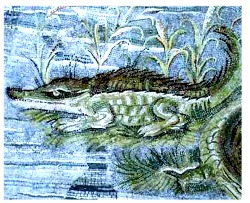
A most intriguing mosaic from the same era was discovered in the ancient city of Pompeii, Italy. It was in the year 79 A.D., on the 24th of August, that Mount Vesuvius erupted, sending a hot cloud of vocanic ash through the city of Pompeii, preserving the ancient relics and artifacts within (9). It was from the house of a rich physician in this city that the "Hunt" mosaic was discovered. The mosaic shows people interacting with, or hunting, reptiles and large animals. The most unique aspect of this mosaic is the fact that the creatures are not normal animals one would expect to find. A man is riding atop a large reptile with vertical plates along the ridge of its back. The creature is not a poor fascimile of a crocodile because, elsewhere in the same mosaic, an accurately rendered crocodile is seen resting on a bank (9). Why more people are not aware of these amazing pieces of history appears to be due to an intentional suppression of the existence of these ancient Roman mosaics. If both these mosaics, all the abovementioned artifacts, engravings, and artwork were actually studied by unbiased scientists, historians, and other experts, and judged without any preconceived beliefs regarding the nature of the objects, then history books would likely have to be rewritten.
Considering the evidence above, a few questions emerge. Did ancient cultures believe that dinosaurs existed with humankind? Did ancient people actually see dinosaurs and encounter them? If so, did they tell their descendents what they witnessed?
Stories passed down by word of mouth--some of them originating apparently not that long ago--have come out of remote jungles and wilderness areas as western civilization has expanded to distant lands. Such information by word of mouth has come from the Australian Aboriginees, a people who have lived in the sub-continent for thousands of years. According to the Aboriginees, a number of large and powerful creatures once inhabited the vast expanse of Australia.
The Bunyip
In July 1845, and article appeared in the Geelong Advertiser of Victoria, Australia (12). It described the discovery of an un-fossilized bone of an unknown, giant animal. When the bone was shown to different, separate Aboriginal tribes, they all immediately identified it as a "bunyip" bone. The tribes were quite distant from each other and had no way of communicating with each other (12). According to their descriptions of the "bunyip", the animal was big, laid eggs, could walk on two feet, and was considered dangerous (Driver). According to the Aboriginees, the "bunyip" had "the characteristics of a bird and an alligator" (12). One native claimed that some deep scars in his skin were caused by a "bunyip" (12).
The Yarru
The Kuku Yalanji is a tribe located in rainforest of Far North Queensland, Australia (12). A missionary, Dennis Fields, learned from the elders of the Kuku Yalanji that a creature called the "Yarru" used to live in large waterholes in the rainforest (12). When Dennis Fields asked a tribal artist to paint the "Yarru" for him, the result was astonishing. The artist, who had no knowledge of what textbook dinosaurs or extinct creatures were supposed to look like, created a painting that was an accurate portrayal of what appeared to be a plesiosaurus (12). The painting was based entirely on the descriptions passed down to the tribal artist from ancient stories (12).
The Kultra
A creature that is described as a quadruped with a long neck and a long, pointed tail is said, by the Central Australian aboriginal tribes, to have lived in swamps which once covered the region. The Aborigines call this creature the "Kultra" (12). From the descriptions they give, it appears to be a type of sauropod.
The Mokele-mbembe
Thousands of miles away from the jungles of Australia, another rainforest spreads its leafy canopy over a vast area. The Congo Basin covers 1.5 million square miles with a swamp-filled jungle (3). Filling up a large portion of the Congo Basin, the Likouala Swamp is the largest swamp in the world (21). Covering roughly 55,000 square miles, an area larger than the state of Florida, the Likouala Swamp has been officially declared by the People's Republic of the Congo to be 80% unexplored (21). Over the years, starting in the year 1776 and up to the present time, people who have traveled to the Congo and talked to the native people have heard about a large creature that the natives call the "Mokele-mbembe" (21).
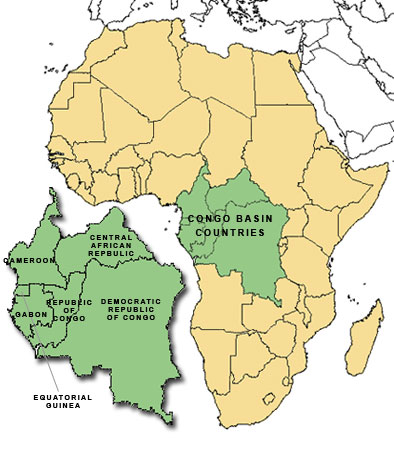
Various expeditions sent by different countries into the Congo have heard strange sounds coming from the jungle and have seen unusual footprints in the ground. A few have claimed to have actually seen the "Mokele-mbembe". In 1932, Gerald Russel, an animal trader, and Ivan T. Sanderson, a world famous zoologist at the time, were paddling up the Mainyu River in the Congo Basin. Suddenly, a large head, attached to a thick, "swan-like" neck, rose from the water (21). For a few seconds, the creature stared at the two men. Sanderson would later sum up his encounter with these startling words: "I don't know what we saw, but the animal, the monster, burned itself into my retinas. It looked like something that ought to have been dead millions of years ago. As a scientist, I should have been happy, of course, but this encounter was so frightening, so nasty that I never want to see it again" (21).
The natives describe the creature as being generally reddish-brown and about the size of an elephant, with a long neck and a long tail. It is known to devour plants and leave behind rounded tracts with three, prominent claws (21). Thus, it is a herbivore. These descriptions strongly suggest that the creature is a sauropod dinosaur (21).
The Thunderbird
Tribal people from Africa and Australia are not the only ones to have passed down stories about dinosaur-like creatures. Legends about large, scaly reptiles can be found in many ancient cultures. China, Europe, and the Middle East have tales about dragons. Though mythicized, the accounts of large reptiles capable of killing humans can hardly be the result of some highly imaginative people around the world who all happen to imagine very similar creatures. Though they do not have stories about dragons, Native American tribes, isolated from the rest of the world by giant oceans, have stories about dinosaur-like creatures. The Thunderbird is one such creature. The Thunderbird is claimed to have a huge wingspan and claws that it uses to pick up people. The belief is that the Thunderbird causes storms. Over the years many people have claimed to see a giant bird or pterodactyl flying through the air. As recently as the 2000s, people have claimed to have seen large, flying creatures. In the year 2001, several sightings of huge, "grayish-black", winged creatures were seen on June 13, July 6, and September 25, by various witnesses, in the state of Pennsylvania (32).
The Ogopogo

Besides the Thunderbird and the Water Panther (mentioned earlier), Native Americans also have another legend about a dinosaurian creature they called the "N'ha-A-Itk", which is commonly called the "Ogopogo". According to Native American legends about the N'ha-A-Itk, a "demon-possessed man" killed a tribal elder on the shores of a lake near his home (28). Completing his dastardly deed, he ran away, fearing retribution. Angered at the murderer, the gods captured the demon-possessed man, turned him into a "serpent", and cast him into the lake (which later was called Lake Okanagan) (28). He was to remain forever at the scene of the murder, as punishment. People who lived near the lake called the creature N'ha-A-Itk (28). It was later that the moniker Ogopogo was more commonly used, which was based on a line from an old song. To this day, sightings of a creature in Lake Okanagan have been reported (28). Besides Lake Okanagan, Lake Champlain, Lock Ness, and other lakes have had sightings of large creatures. Is it possible that some people actually have seen dinosaurian creatures in these lakes and have not been hallucinating or imagining what they have seen?
Ancient petroglyphs, pictographs, figurines, carvings, mosaics, stones, engravings, and legends on the subject of dinosaurian creatures are all interesting and intriguing pieces of possible evidence that dinosaurs may have (or possibly still do) lived as contemporaries of man. A question arises: If dinosaurs really had lived with humankind, explorers, scientists, or archeologists would most likely have found some remains or evidence to concretely prove it, correct?
Dakota
In 1999, Tyler Lyson, 16 at the time, was walking through the Hell Creek Formation badlands of North Dakota (25). His eyes locked onto a strange object protruding from a hill. As he looked at it longer, he realized it was a dinosaur bone. Five years later, excavation on the site began. On December 3, 2007, scientists announced to the world the discovery of a nearly intact, mummified hadrosaur, nicknamed "Dakota". According to an article from Wired.com, the dinosaur's "entire skin envelope appears to remain largely intact (25)." Phil Manning a paleontologist at University of Manchester (in England) who was leading the examination of "Dakota" said that the integrity of the skin envelope suggests that Dakota may have other "soft-tissue remnants" such as organs and muscles (25).
Leonardo

Discovered by a Judith River Dinosaur Institute expedition in the year 2000, and presented to the world in 2002, Leonardo is a duck-billed dinosaur (or a brachylophosaurus) that "will advance our science a quantum leap", according to Nate Murphy, curator of paleontology at the Phillips County Museum in Montana (18). The brachylophosaurus is estimated to have been either 3 or 4 years old when it died (37). Leonardo's muscles, skin, scales, foot pads, and a stomach are still intact. Skin scales and tissue have been found on less than a tenth of one percent of all the dinosaurs excavated over the years (18). Amazingly, 90 percent of Leonardo's skeleton is covered in soft tissue, such as a beak, nails, skin, and muscles (18). The actual tissue cells have been replaced by minerals, but the stomach contains a partially digested meal and scientists can actually see what exact plants the dinosaur had eaten (18). Ferns, magnolias, conifers, and the pollen of more than 40 different plants form the contents of the animal's stomach. It is likely that these all mineralized slowly over millions and millions of years without decaying?
B. rex

Discovered in the year 2000, the skeleton of a young, 18-year-old Tyranosaurus Rex (19) has drawn a lot of attention from scientists and laymen alike. The dinosaur skeleton was named "B. rex" after Bob Harmon, chief preparator of paleontology at the Museum of the Rockies, who discoverer it (2). Because the dinosaur was too large to take by helicopter, it had to be broken in pieces (19). As a result, a thighbone was cracked open and Mary Higby Schweitzer and her team were able to examine the interior of the bone (19). What they discovered has shaken the scientific community, causing scientists to reconsider their long-held beliefs about dinosaurs. Inside the bone were life-like tissues that should not have been inside a "65 million"-year-old Tyrannosaurus Rex (39). According to an article in Discover Magazine, Schweitzer found "supple bone cells, their three-dimensional shapes intact; and translucent blood vessels that looked as if they could have come straight from an ostrich at the zoo (39)." Hillary Mayell of National Geographic wrote about the discovery: "The vessels resemble blood vessels, cells, and the protein matrix that bodies generate when bones are being formed (19)." If the dinosaur was indeed 65 million years old, how could the actual cell tissues be preserved for so long? These tissues were not replaced by minerals and they were not mummified. Blood vessels, cells, and a protein matrix could hardly survive for a thousand years, much less a million. Is sixty-five million years with little decomposition possible?
The Age of B. rex

According to evolutionists, the earliest man (homo sapiens) existed in Africa nearly 200,000 years ago (23). The earliest form of civilization is considered, by evolutionists, to have come into existence 10,000 to 12,000 years ago (30). To get a picture of the length of time involved, imagine living to an old age of 100. Now, imagine, by some miracle, you keep going on and you make it to the age of 200. Say that scientists find a way to greatly extend human life spans and you get your life span extended so that you live a thousand of these 200-year-long life spans. You are now at an age equivalent to the time that has supposedly passed between the emergence of the earliest homo sapien and the present. You've live an incredibly long life. You've seen civilizations come and go, new buildings decompose into dust, animals become extinct, bodies die and rapidly decay into their constituent elements, and you've seen skeletons petrify. Now, imagine living 325 of these extremely long (200,000 year) life spans. You have finally reached the purported age of "B. rex". Think about all that time you spent and all the things you saw decay to dust. Does it make any sense at all that the cellular tissue within the bones of "B. rex" are millions and millions of years old? Is it possible that the methods evolutionists use to date dinosaur bones are erroneous?
When scientists at Oak Ridge National Laboratory used the Carbon dating method to find the age of some dinosaur bones, they came up with an age of only a few thousand years (31). Because this date did not fit their beliefs about the age of dinosaurs, they ignored their findings and decided to use other methods instead (31). Some of these results can differ from each other by as much as 150 million years (31).
Soft tissues normally decompose quickly after an organism dies (6).
Therefore, is it likely that blood vessels and soft tissues could continue to exist inside a dinosaur bone for millions of years? Scientists with evolutionary beliefs have scrambled to come up with a plausible and realistic explanation for how the soft tissue found within the thighbone of "B. rex" was preserved for what they assume to be 65 million years. So far, they have no explanation they all can agree on.
Conclusion
If one believes that dinosaurs died out millions of years ago, long before mankind came into existence, why does such an abundance of artifacts and legends on the subject of large, dinosaurian creatures, coming from ancient cultures around the world, exist? Is it possible that the figurines, stones, petroglyphs, pictographs, engravings, carvings, mosaics, and legends depicting and describing large reptile-like creatures are based on animals that ancient humans actually saw alive? Is it possible that our ancestors saw living dinosaurs and told stories about their encounters with the dinosaurs, passing down the tales by word of mouth? Could our methods for determining the age of dinosaurs be flawed? These are questions we need to ponder. The implications for the Theory of Evolution are numerous and profound. One such implication leads to an important question: Did humankind and dinosaurs live together instead of millions of years apart, as evolutionists claim? I leave my readers to come to their own conclusions based on the information presented in this article.
However, if one spends his (or her) life researching this information with an unwavering, adamant belief that God does not exist, he will not believe any new evidence that is stronger than what we presented. Nothing will change such a person's mind because he or she doesn't want to believe in God or be accountable to the Creator. God loves us and wants us to be with Him in Heaven, but He will not force us to believe in Him. We have the choice to accept God's
free gift of eternal salvation and serve God or reject eternal salvation and serve ourselves, but the consequences of such a decision will be eternal.
The Bible says:
Revelation 20:10-15 (bold / underline added)
10 And the devil that deceived them was cast into the lake of fire and brimstone, where the beast and the false prophet are, and shall be tormented day and night for ever and ever.
11 And I saw a great white throne, and him that sat on it, from whose face the earth and the heaven fled away; and there was found no place for them.
12 And I saw the dead, small and great, stand before God; and the books were opened: and another book was opened, which is the book of life: and the dead were judged out of those things which were written in the books, according to their works.
13 And the sea gave up the dead which were in it; and death and hell delivered up the dead which were in them: and they were judged every man according to their works.
14 And death and hell were cast into the lake of fire. This is the second death.
15 And whosoever was not found written in the book of life was cast into the lake of fire.
If a person rejects Christ, he or she will be cast into the lake of fire. I don't write this to scare you. This is what the Bible teaches. I urge you to turn to Jesus and accept Him today as your personal Lord and Savior.
Forsake sin and live.
Would you like to find out how to Know God's Name Personally?
IF YOU ARE SEEKING TO KNOW GOD, please read this message.
1 Timothy 2:5: “For there is one God, and one mediator between God and men, the man Christ Jesus;”
Acts 4:12: “Neither is there salvation in any other: for there is none other name under heaven given among men, whereby we must be saved.”
Ephesians 2:8-9:
8 For by grace are ye saved through faith; and that not of yourselves: it is the gift of God:
9 Not of works, lest any man should boast.
God loves us so much that He sent His Only Begotten Son, Jesus Christ, to die for our sins and shed His precious blood to pay for all of these sins. (See John 3:16; and 1 Corinthians 15:3-5; and Romans 5:8-11.)
If you repent (turn away) from your sins (Acts 3:19), and believe and confess aloud that Christ has done this for you (Romans 10:9-10), and have made Him your Lord and Savior (again Romans 10:9-10) you are saved.
Now seek God with all your heart. Seek to know Him and you will (Jeremiah 29:13).
John 17:3: "And this is life eternal, that they might know thee the only true God, and Jesus Christ, whom thou hast sent.”
Jeremiah 29:13: “And ye shall seek me, and find me, when ye shall search for me with all your heart.”
John 14:6: “Jesus saith unto him, I am the way, the truth, and the life: no man cometh unto the Father, but by me.”
Acts 4:12: “Neither is there salvation in any other: for there is none other name under heaven given among men, whereby we must be saved.”
 Many studies have been undertaken to see how violent video games effect children. One such study shows that there is a connection between violent video games and aggressive behavior. Dr. Craig A. Anderson, Ph.D., of the Iowa State University in Ames has conducted a study on the gaming habits of over a thousand children from Japan and the United States (7). The study has revealed some startling facts about the effects of video games on children.
 While there is controversy over whether all genres of violent video games are harmful, research regarding the effects of violent video games on the brain has brought up some startling results. According to a fairly recent study by Dr. Vincent Matthews of Indiana University, computer games have an impact on the brain. A number of participants, ages 18 to 29, were randomly chosen to play a Mature-rated, first-person shooter game (13). The other group played no computer games during the study. None of the participants had much experience playing computer games and all were men (9).
 After one week had passed, both groups were given counting and emotional tests and scanned again by the functional MRI machine. The scans revealed that the game-playing group had less activity in the areas of their brains where attention, emotions, and the restraint of impulses are centered (9). The group that played the Mature-rated game did not respond to emotional content as they had during the first test (13). A test that involved counting revealed that the video game group had decreased activity in the areas of their brains where concentration and attention are controlled (9).






 We will focus first on listening in an audience. Listening to a speaker, such as a professor, is highly important if you want to succeed at your class or job. Companies lose thousands of dollars each year due to poor communication. According to a study by SIS International Research, roughly 70 percent of the employees of a business waste an average of 17.5 hours each week dealing with problems caused by poor communication1. That’s a huge chunk of time and money lost! So, how can we improve our listening skills? A study conducted by Larry Vandergrift, a University of Ottawa researcher, revealed some interesting facts about how to improve listening skills in the auditorium.
  2. Before going to the speech, mentally review what you know about the topic of the speech. Your knowledge is a foundation which you can then build on. When you review your knowledge on the subject before the speech, you’ll be more aware of how the new information from the speech fits in with what you already know. This makes it easier to learn. Learning based on past knowledge is important for progress.
 4. Don’t get distracted. The people around you text messaging, the speaker’s resemblance to someone you know, the people standing up and leaving the lecture, and your own thoughts can cause you to get easily sidetracked. Don’t let them. Keep your eyes on the speaker and your thoughts on what is being said and what it means.
 Artifacts depicting images of biblical events have been discovered all over the Middle East. One insightful depiction can be found in the south wall of the Great Temple of Amon at Karnak, in Egypt (5). A huge sunken-relief of Pharaoh Shishak (or Shoshenq I), with a number of small depictions of ancient Hebrews surrounding it, catches one’s attention while walking through the temple. Commissioned by Shoshenq I, the relief of the pharaoh also contains writing describing a campaign in Israel where he sacked a number of cities and took the plunder back to Egypt with him (5). The Bible records Shishak’s campaign in 2 Chronicles 12:1-9* and in 1 Kings 14:25. Rehoboam the king of Judah “forsook the law of the LORD, and all Israel with him” (2 Chron. 12:1). Then, “in the fifth year of king Rehoboam Shishak king of Egypt came up against Jerusalem, because they had transgressed against the LORD…and the people were without number that came with him out of Egypt…. And he took the fenced cities which pertained to Judah, and came to Jerusalem” (2 Chron. 12:2-4).
 The Victory Relief of Shoshenq I records that he attacked various cities in the northern kingdom of Israel in addition to cities in the southern kingdom of Judah (11). Further confirmation that this event recorded in the Bible and in the Temple of Amon actually occurred is found in Israel, at the site of Megiddo. At Megiddo, a section of a stela (an upright stone slab) was discovered in 1926 during some excavations (11). On this stela, commemorating Shishak’s victory, his name can clearly be seen carved into the stone (11).
  Depictions of events described in the Bible are not limited to Egypt. Located in northern Iraq in the ruins of ancient Nineveh is the Palace of Sennacherib. All that is left of the magnificent home of the Assyrian king, King Sennacherib, is the palace foundation and some of its walls. One particular wall is still mostly intact.



 Vision is important to most people. We would have difficulty navigating our surroundings and writing articles, like this one, if we did not have it. Millions of people around the world do all they can to improve their sight. Some get contact lenses and glasses, spending hundreds of dollars, while others receive laser-eye-surgery, spending thousands. This question should be of interest to those who want to have good vision: “How do we see images?”
  lling light levels, a sensor for capturing the images projected on it, and a lens that automatically focuses (8). The sclera is the white part of the eye. Like a camera’s interior, the sclera is brown, or dark, on the inside. This allows it to absorb light to keep the images received by the brain from being washed out. Connecting to the sclera and covering the iris is a transparent membrane called the cornea. The cornea is a crystal-clear membrane which consists of five layers, totaling half a millimeter thick (2). It alone accounts for two-thirds of the eye’s focusing power (2).